Over the last few years of making yearly themes, I’ve generally had a few ideas come to mind and need to choose a winner. This year, only one came to mind before the new year even arrived. I spent more time than expected trying to dig up other contenders, but EXPRESS is the one option for the theme for 2026.
Express Thoughts and Feelings
As last year came to a close, I found myself in a bad place mentally. Bouncing back a few days later, I started putting together my thoughts for the year end post and reviewed the email thread I sent to my brother throughout the year. Time after time I was reliving moments where my mental health was a wreck. I knew it was time to start looking for proper professional help.
Last month, I touched on my inability to clearly ask for help and believe this is tied to why I’ve put off therapy for so long. I’ve long been an independent person who often enjoys or is at least indifferent to some degree of struggle.
I hope to highlight this issue using two instances of having to take a long walk home. One day while riding my bike to the gym, my tire blew a flat. This was one of multiple flat tires I’d gotten in a short period of time. Frustrated and experiencing one of those mental health breakdowns on the side of the road. I then texted my other climbing friends if any of them were going to the gym that day and if so, could I get a ride home? No one was, but one friend offered a ride. From there I ghosted the group and just walked all the way home.
Contrast this half-assed request to just taking a similar long walk home late one evening. After a roller derby event in the city, I was taking a bus that normally goes right by my apartment when it came to a stop around 5 miles from home. Turns out that was the last bus that day, so it was out of service. It was around 11 PM and pretty cold, as it was early December. I considered ordering a rideshare or calling a friend, but I was feeling alright and decided the walk would be fine. What I didn’t do was reach out, confirm it wouldn’t be an inconvenience and maybe ask for a ride if it really wasn’t a big deal.
All this to say, I want to shed that old habit of not clearly asking for help when I need it.
Express Ideas
Another big win last year was getting back into the habit of publishing posts regularly. Prior to that, I hadn’t fully stopped writing but committing to publishing really forced me to be far more consistent. While not every month last year was a glowing success, I found trying to get something out there at about that rate was a good practice to get moving. I’ve occasionally thought about returning to the trial format this blog was started on, but really haven’t found any “experiments” I’ve wanted to try out.
There were a couple instances I felt what I was writing junk to meet the deadline, and so I am winding my target down to 10 total posts this year. This gives me some breathing room to develop ideas I’m excited to share, rather than put out some mediocre ideas just to hit an arbitrary count.
On the writing front, I also want to develop better skills as a media critic. From movies to games to books, I’ve written reviews on various platforms or had discussions with friends, but I’ve frequently felt times that I lacked either the vocabulary or reference to really explain my thoughts on a given piece. For years, I’ve watched reviewers, mostly for movies and games, but haven’t really expanded my own skill in that area.
I’m targeting around once per quarter to write and post a thorough review of a piece of media I felt impacted me – be it on a technical and mechanical level or it’s narrative and story. After writing my own thoughts, I then plan to look to other critics, taking in their perspectives and learning from what elements they highlight and language they use in their reviews. I hope this develops my skill as both a critic and writer in general.
Keeping Momentum
While 2025 is over, there are a number of things I want to continue into this year – keep the swing going if you will. For one, my brother and I are continuing the regular email thread. This was a great practice to record not only the events of the year, but also thoughts and feelings at the time.
Otherwise, I’m also looking to plan at least one more train trip. Riding the Empire Builder line up to Seattle was such a great time. I’m hoping to explore other train lines and cities, comparing the experience to last year’s trip.
The new year offers a cultural time for change, and I’m excited to continue with the theme concept as we make our way into 2026.
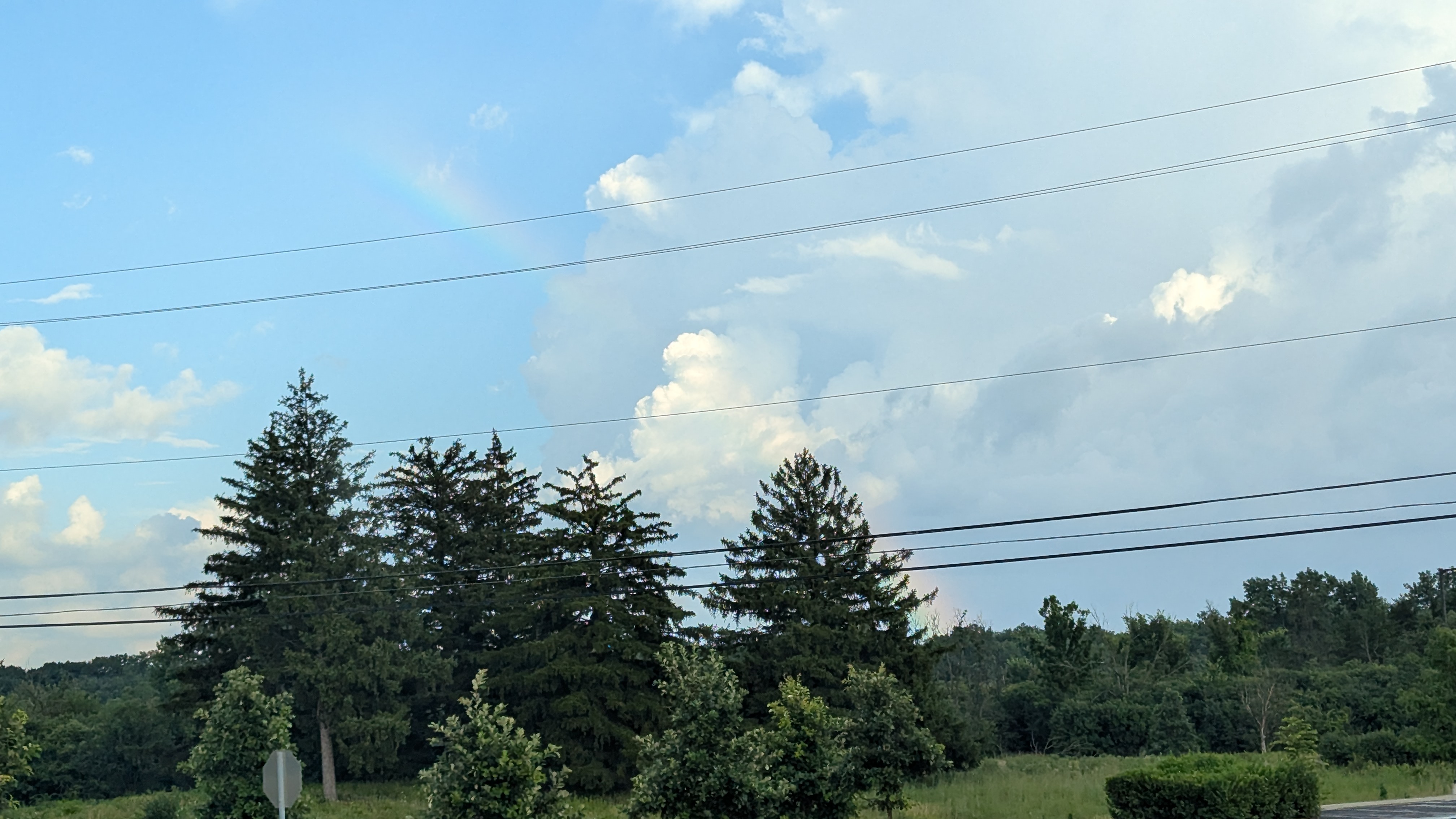
If a rainbow is not photographed, did it even happen?
Back in April, I wrote out a few questions. One of those was to understand the philosophical movement succeeding postmodernism, if there even is one. Over the last few weeks, I started digging into the answer to that question, and the desire to find that answer isn’t mine alone. A variety of writers and philosophers are working to define what comes next, or what is already here.
Pseudo-modernism
Starting with the oldest article on the subject I found, back in 2006, Alan Kirby wrote for Philosophy Now, “The Death of PostModernism.” In the article, Kirby explores the evolving culture movement away from what he describes as postmodernism’s “fetishizing” of the author or creator towards that of the recipient, user or consumer.
I agree with many of the points throughout the article. It’s clear that art and media have shifted into everchanging forms due to how consumers have become a part of them.
Where I disagree with Kirby is his belief that there is no interaction or exchange between the author and consumer. Maybe it was due to the state of media at the time, but today we can see this in the form of what is colloquially called “content.” Content isn’t just media, it’s creation for the intent of consumption and interaction of the creator and audience. Platforms like TikTok, YouTube, Instagram and more exist to host content, encourage engagement and leverage advertising within this engaged context.
Kirby also references what I consider the most interactive form of media, videogames. A movie can play without an audience to watch it, but a game needs interaction to progress its acts. Though I find his interpretation of these to be quite shallow. He discusses games as brief interactions and then they are obsolete. I understand some of his point, that specific interactions in pseudo-modern art are fleeting. The contents of an internet page can be altered. For a less technological example, a radio call in show can only truly occur once. That given call exists in a vacuum and cannot be recreated, even if the caller and host exchange the exact same words, their context is now repetition. Back to games, I think this misses the impact that the interactivity of games offers. I still think about and have conversations about the effect the Kingdom Hearts series has had on my worldview. I don’t think the games would have had the same level of impact as another media like a book or movie.
At lot has changed since 2006. There are nearly 20 years of technological and cultural changes between Kirby’s original article and now. Kirby often cites the emerging reality TV shows and an internet that is far from what it once was. His description how each internet user harkens back to a time before the internet became more or less a handful of websites almost all traffic go to. Describing each user taking their “own path” seems archaic now with the current internet landscape of social media and search engines all under the same handful of tech companies.
Algomodernism
The foundation of many of these thinkers is the evolution of the internet and especially now the emergence of generative AI and data algorithms. In what is the most recent post I read on the subject, at the beginning of this year Bradley Murray wrote a piece for his site Philosophies of Life on what he calls “algomodernism.”
The main idea I saw in Murray’s piece was the way postmodernism and algomodernism approach metanarratives and how common knowledge is viewed. A metanarrative is a grand unifying truth, story or reality. If postmodernism is a rejection of modernism’s metanarrative, algomodernism is a return to metanarrative. Murray defines algomoderism as “a paradigm in which we look to AI and related complex algorithms to generate narratives that define fundamental aspects of ourselves and the world.”
This is the ideology I most disagree with, at least at time of writing. Unless new evidence emerges regarding generative AI, I am very skeptical of this leading to a shared worldview or common truth. If anything, I see these tools as deeper entrenching people in echo chambers, just as algorithmically driven content has for the last couple decades.
Generative AI is known to make up facts and is designed to be highly agreeable, in order to maintain user engagement. This is a recipe for deeper fractioning of a common narrative.
Putting AI agents aside, Murray points to the pathways of the internet – to steal a term from Kirby – are now well trodden. How many of us Google a website as compared to going to the site directly or in some cases even remember the name. “Google” itself has become a verb to perform a search online. Beyond Google, how many websites beyond the major social media platforms are even used?
The niche corners of the internet are certainly still around, but more and more time is spent in the same places. However, even these sites are vastly different due to how much of their content is driven by individualized algorithms. Even among my closest friends, we can open the YouTube homepage to vastly different results. This is where my skepticism for this metanarrative is based. These technologies have only seemed to further atomize society, not unite us.
Postpostmodernism
The least creative of the naming schemes is certainly the least defined of the ideas I explored.
This video lecture by Julian de Medeiros is going to be my reference point for “postpostmodern.” I’m sure there are many ideas to what may be called postpostmodernism. While never explicitly defined in the video, my understanding is that this form of postpostmodern leverages contradictions to increase value, utility (in the economic sense) and happiness.
The first example used to explore the postpostmodern was the Banksy auction from a few years ago in which upon being sold the piece of art was shredded. This act of shredding was ultimately a piece of the overall form, perhaps linking back to Kirby’s ideas regarding the audience’s participation or exchange. What de Medeiros sees in this moment as postpostmodern is the disconnect of value from the piece of art itself and onto its destruction.
From here de Medeiros describes the postpostmodern as a “pseudo revolution.” Not a true alternative or rejection of postmodernism, but an extension of it. I find the example used to describe this pseudo revolution fascinating as it once again sees some semblance of Kirby’s ideas from 2006. Using the example of the BLM movement “social media blackout” in which black squares or screens were used to show solidarity, rejecting creation of content for major platforms, a form of content is still being made. This bridges into what I think is the most interesting point made in the lecture, the contentification of life. To quote de Medeiros directly, “unless it exists as content, it doesn’t exist.” A fitting phrase for our content raddled society.
Another factor of postpostmodernism is the ability to extract surplus (value, wealth, utility, entertainment, etc.) from seemingly contradictory factors. The example used in the lecture is a CEO who hires a dominatrix in the evenings. The executive is able to extract value from not just power and domination, but in a lack of power and submission.
The final piece I’ll touch on from this lecture is one I really connect with, the movement towards sincerity in art and media. For a long time, cynicism and irony have been the tone by which art was presented. Speaking for myself, I’ve grown tired of this attitude and find myself enjoying and gravitating towards works that are direct and wear its heart and emotion on its sleeve.
There was certainly a lot in this lecture, a lot of which I haven’t completely taken in, but I highly recommend giving it a watch. At roughly an hour, it’s a great primer on postmodernism and in what ways we are beginning to move beyond its tropes and ideas.
What do I think?
As I look at the world today, I think there are elements of all of the above for all of us, not as philosophers, but as everyday people to consider.
To start, the internet is a source of information, not truth. For every idea, there is surely an opposing viewpoint with some form of evidence to back it up. Said evidence may be completely fabricated or simply misrepresented, but surely there will be a basis on which a given perspective or belief is shared. This may ultimately lead to a post-truth world.
What is to be done if we cannot rely on truth? I think this is where principled action is required. I think there’s a reason that even right wing MAGA voters are being turned by the End Oligarchy tour throughout this year that Bernie Sanders, AOC and others have been touring around the country. People see these principled stances that these leaders have had for decades and those resonate. In those moments they forget about some talking head calling Sanders a communist or Socialist. The same goes for Zohran Mamdani’s mayoral campaign that confused Democratic leadership for the last year. Unlike Bernie, Zohran is a self-described socialist. Time will tell how successful his policies are for NYC, and I do hope they are successful. At the end of the day, a large number of New Yorkers are willing to bet on a Muslim socialist, an unexpected outcome in 21st century America.
If we have to reject specific truths, metanarratives will need to do the work towards creating better lives for everyone, even those we disagree with. Even once contended points of truth are slowly becoming an agreed upon metanarrative.
 Trying Out Before Buying In