Infinity and Beyond

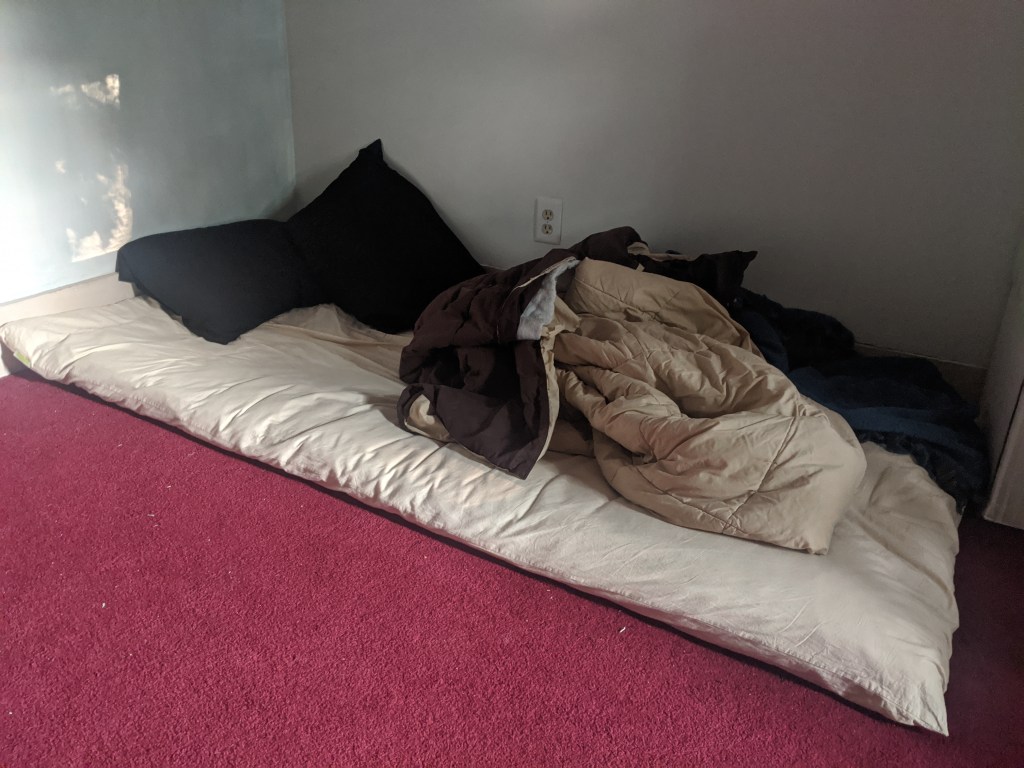
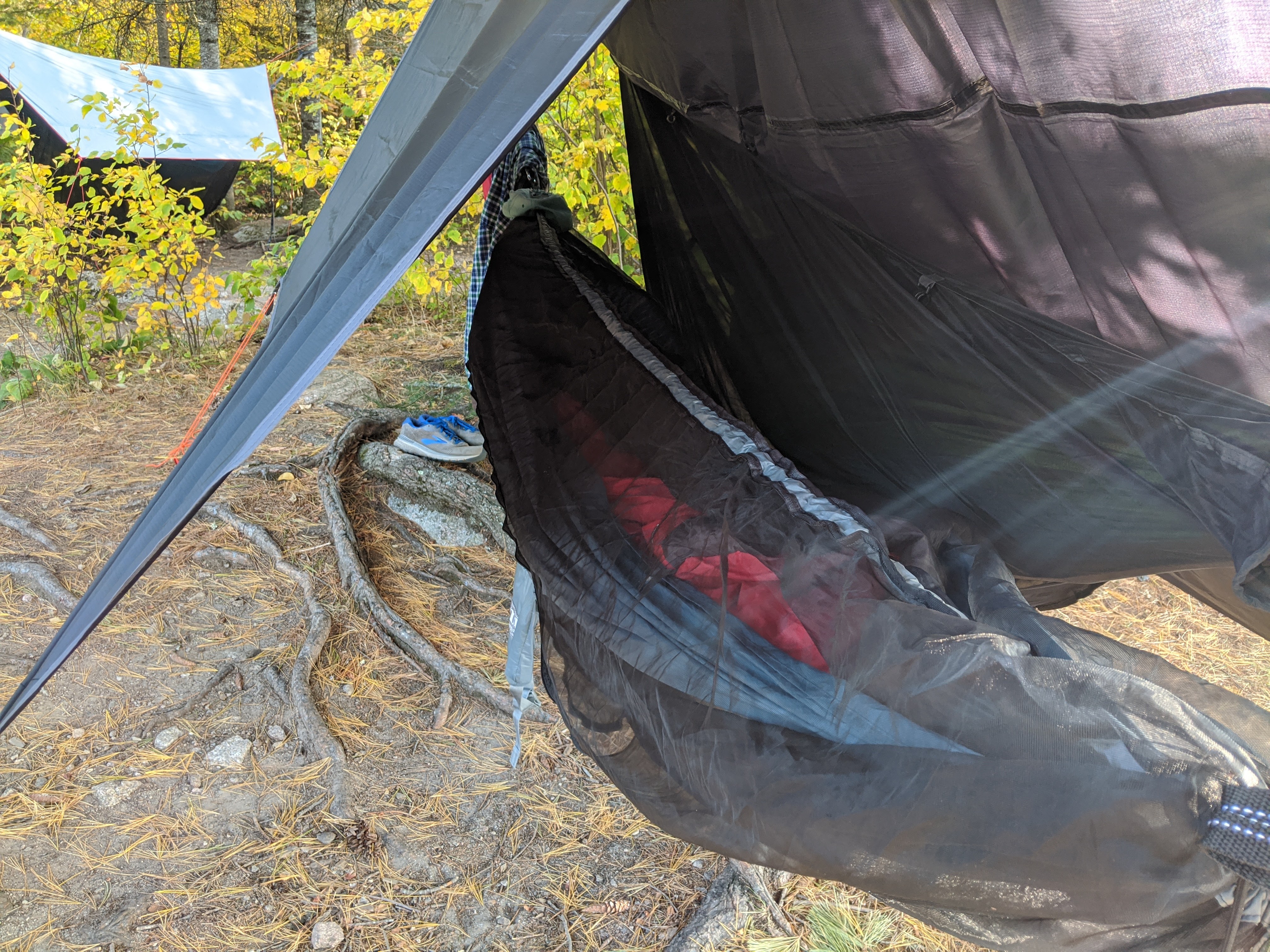
The temporary sleeping station.

This week was a rather odd one for the conclusion of this experiment. I spent most of it camping with some friends, causing all of my rules to be effectively useless by design. While out in the woods, I still thought about each space we were in and the activity associated. First, a recap.

Results of the Rules

My goals from the beginning of this trial were to reduce distractions while working to 15 minutes per day, fall asleep within 15 minutes of laying down, and to start a morning fitness routine.

The first, I feel has seen progress over the experiment. Before this trial, I fell into the bad habit of throwing on entertainment content while working at my day job or on personal projects. Eliminating the ability to watch said content at my desk, aka the creation station, has led to greater focus when at the desk.

Using my bed as only a place for sleeping was probably the biggest challenge across the goals. There were a number of long days that I wanted to lay down and watch a video before sleeping, but I had to resist and choose either sleep or watching elsewhere. It’s hard to say if I have hit the 15 minute goal exactly, but I know it’s around there based on a sleep meditation I listen to as I go to bed.

The fitness routine wasn’t so much a challenge as just not happening. The first couple of weeks started okay. Seeing the mat rolled out prompted me to do some form of exercise. As time went on, I was still getting a decent workout in, but it just happened after work, a long-standing habit of mine. Perhaps I need to accept my fate of not being a morning workout person.

All in all, I plan to keep the rules in place. I really think they are benefitting me across several areas in life.

Beyond the Spaceship

Throughout the past week, a few friends and I went camping in Northern Minnesota. The trip consisted of several hours of canoeing in between each site. After reaching our site for the day, we would set up camp and relax. Each time we set up, I thought a lot about the space we were in.

The sleeping space was clearly defined as our tents and hammocks. The recreation station was around the fire in which we would get a lengthy chat going each day. The remaining two are a bit strange in this case, because our work and fitness were kind of intertwined. The canoes themselves were a workout to get to our objective each day.

This has me considering spaces wherever I go. As someone who has worked remotely for nearly two years now, I’ve worked in a number of places – from coffee shops to friends houses and even a highway rest stop once. The places I go can always be used for anything. I think it’s important to maintain the sanctity of the stations, beyond the ship itself.

What are some places in your life where you need to create boundaries for your stations?

What’s Next

This next trial has been a challenging one for me to find. I typically take a combination of my latest interests and where I can see improvements. This experiment may or may not click for some and may interest others.

I mentioned previously a growing interest in the game Destiny 2. In an attempt to get better at the game, and PC games in general, I plan to start an “aim training” regiment. The goal is at least three days a week following a series of routines credited to an author known as “AIMER7.”
Touring Spaceship You

This week, I thought I’d offer a tour of the room I’ve been referring to as my Spaceship all week. Going through what’s in each station, and how I use it, might be a fun alternative to the usual post on here.

Getting Things Done – The Creation Station

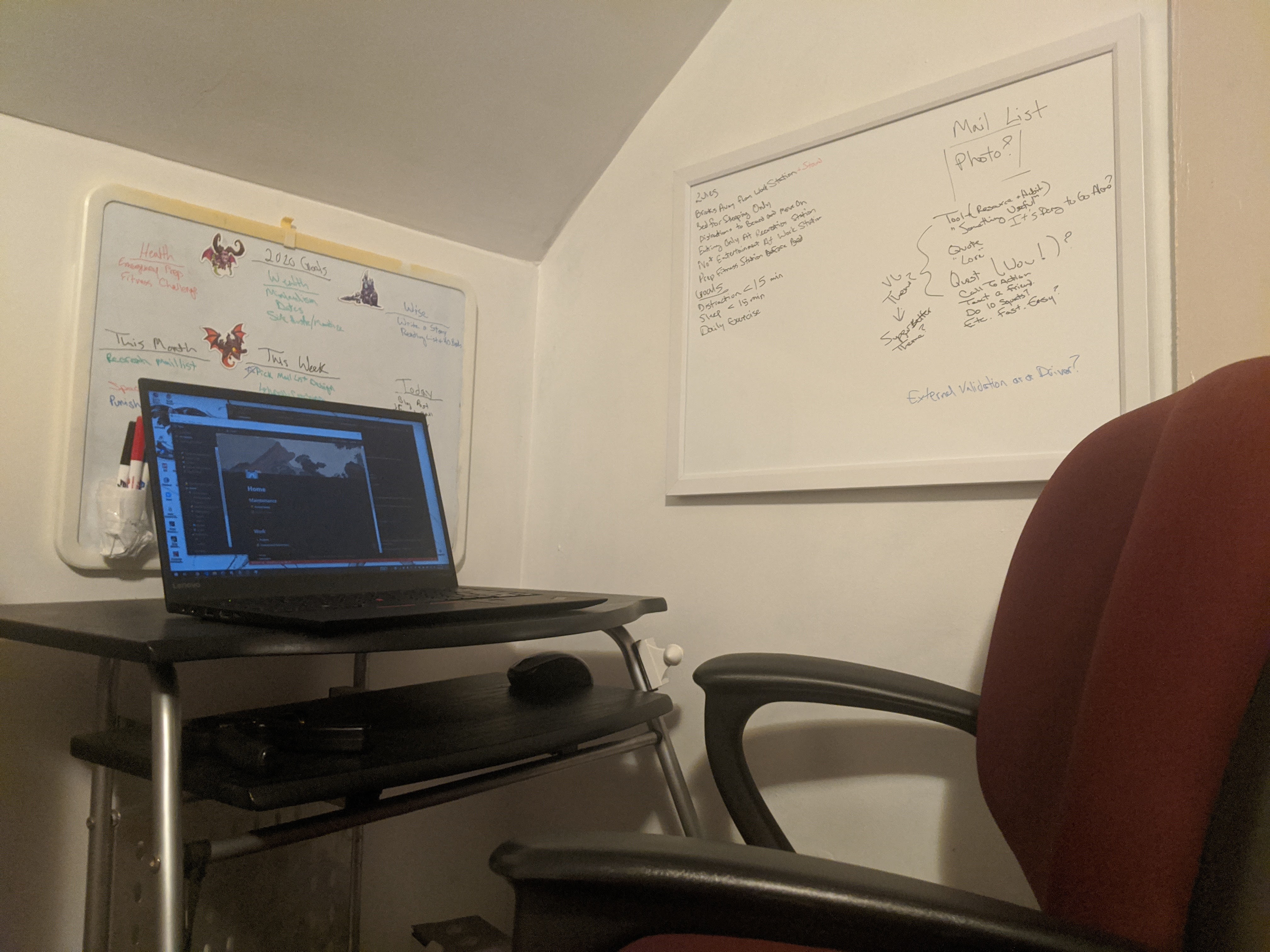
The fundamentals.

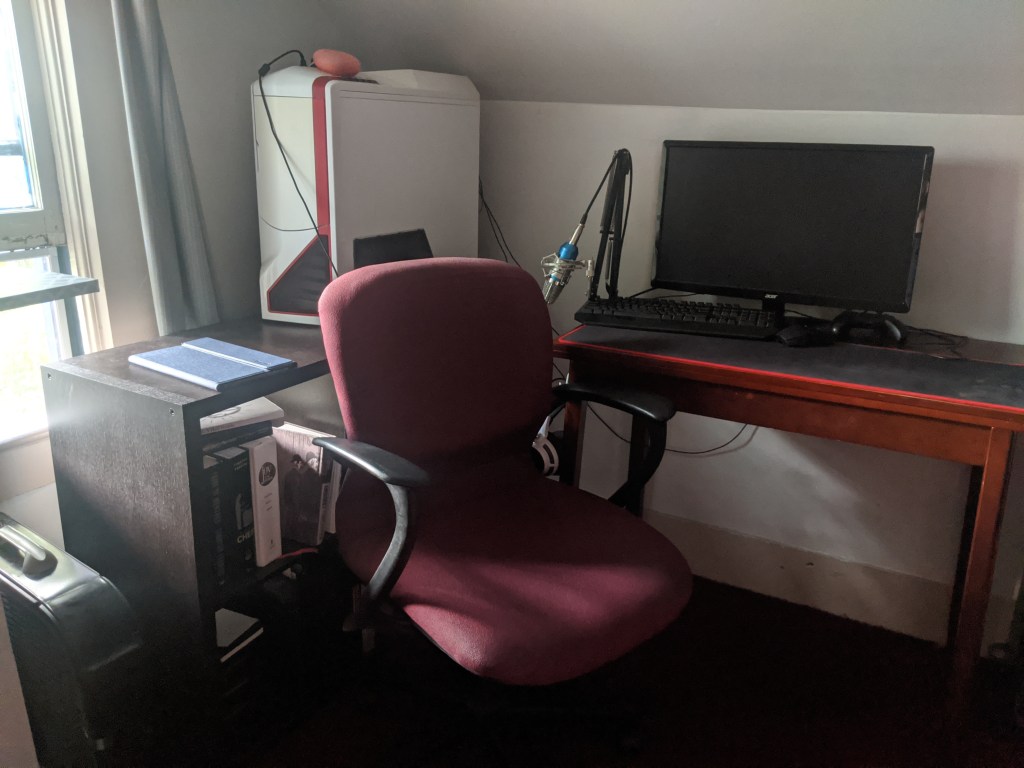
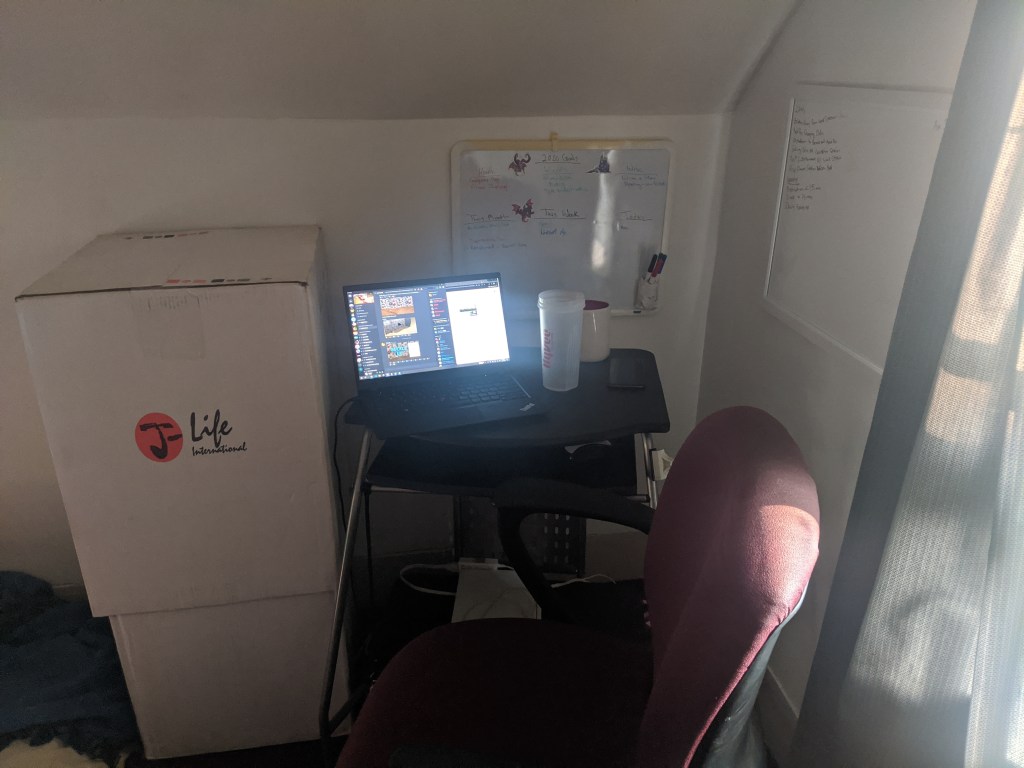
The best place to start is where I spend a good portion of each day, my work desk. This is where I go while working remotely for my day job and on personal projects, like writing this post.

I’ve been referring to this as the work station throughout this series of posts, but I now prefer Grey’s original name, the creation station. The name decouples the space from the burden of work and offers its purpose as a place to get things done.

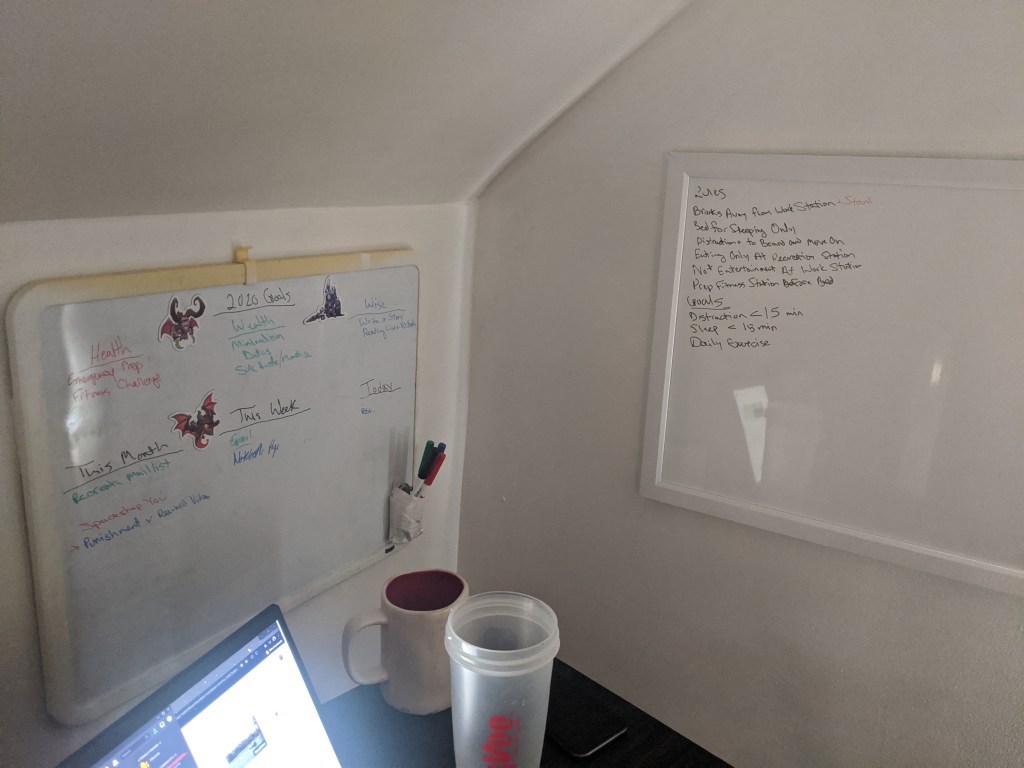
It’s a simple setup with a desk I’m borrowing from a roommate, the box from my bed, and a couple of white boards. I like having the option to sit or stand depending on how I’m feeling, though as of late it’s been a lot more sitting.

Hanging the white boards was a recent addition just before starting this trial. Before, I just had one that drifted around the room for jotting down quick notes. Now, I have one that’s used for quick note taking, and the other acts as a reminder board. The reminders consist of my goals for the year and the things I want to get done in a given day, week, and month. It’s beneficial to jot down and review notes for just about any project or goal.

Unwinding – The Recreation Station

This desk was actually where I was working for a long time before the release of the Spaceship You video. After watching it, I decided to isolate the two areas. The breakdown of that boundary being a major inspiration for starting this trial.

This chair looks familiar…

Since setting this area aside, I feel I’ve given myself permission to play more games. Last year around this time, I actually didn’t boot up my gaming PC for something like four months. I kept finding other ways to stay busy that I didn’t spend as much time gaming. Throughout the quarantine and general uncertainty of our times, I’ve had a lot of great times playing games of all kinds alone and with others.

Admittedly, the scale has begun to tip. A desire to start playing the game Destiny 2 again has led to some late nights. Setting limits here is something I’ve needed in the past, and I’m glad I had those in place. The biggest of which is a scheduled shutdown on my PC at 11 PM, which has been utilized more than once just this week.

While gaming on my PC is one of the frequent activities in the recreation station, I also use this desk for reading, streaming videos, and chatting with friends and family. I do spend more time watching shows or movies in the living room, but in terms of the space in my room, this is the place to do it.

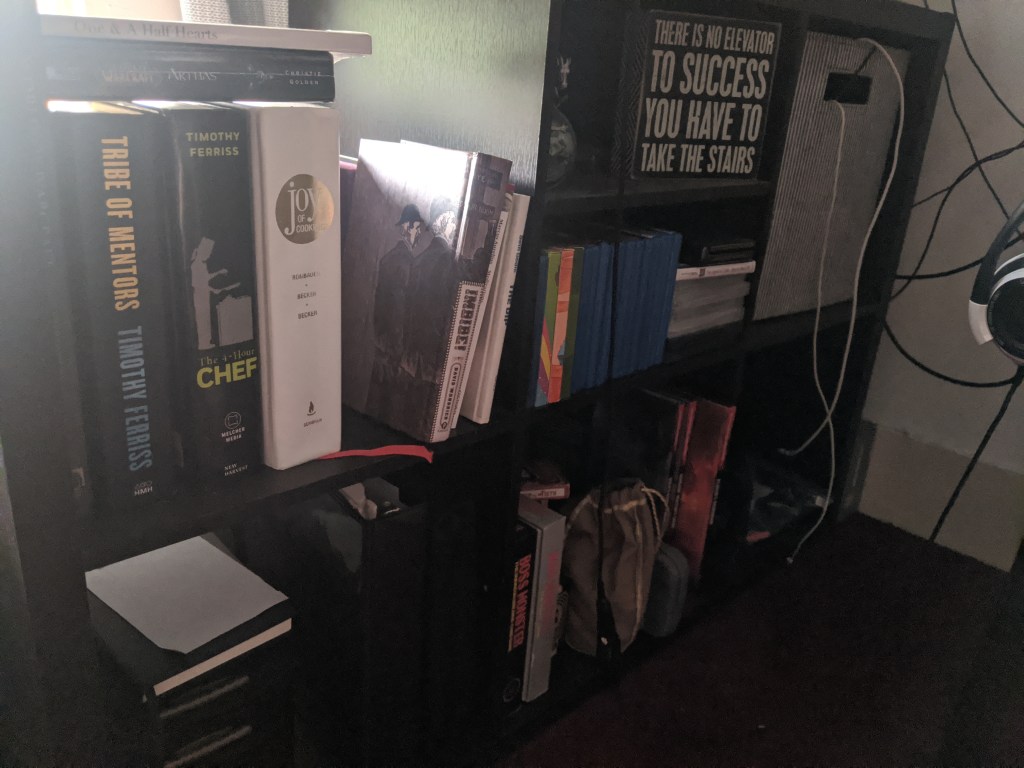
Here’s a collection of my books, movies, and games.

Sharpen the Saw – The Exercise Station

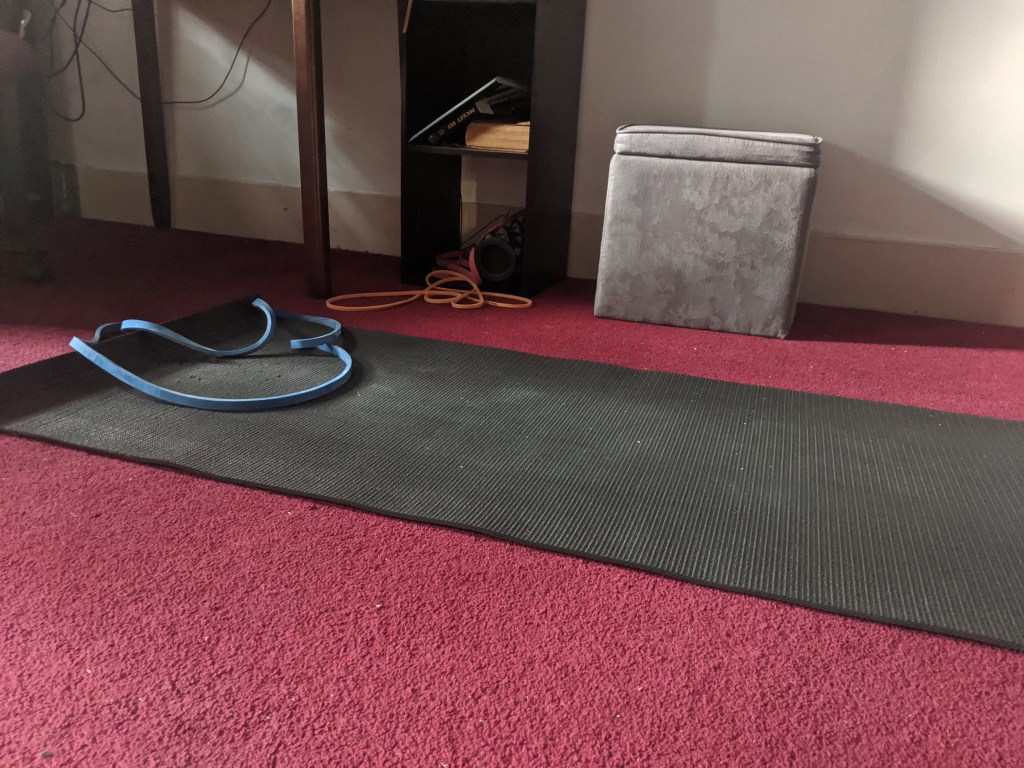
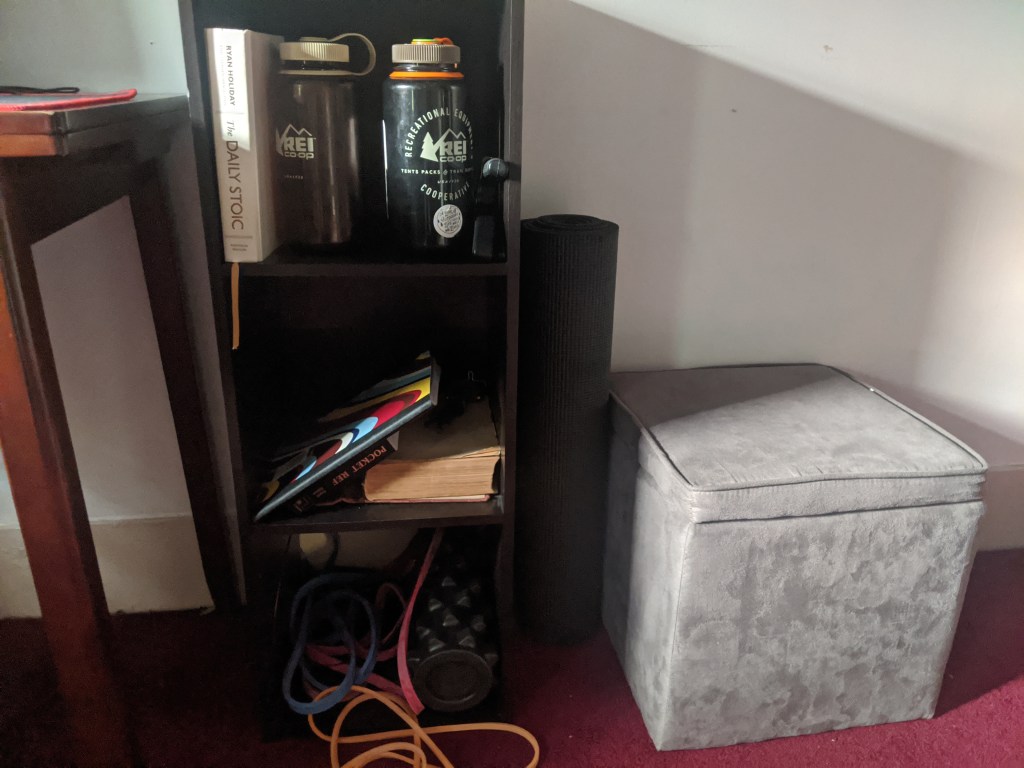
While definitely the least used station it is far from the least useful. Having a quick and easy way to exercise all but forces me to get some kind of workout in before the day is over. Whether it’s a few bodyweight sets, pulling some resistance bands, or a yoga session, I can do something with my body that almost always has me feeling better both mentally and physically.

This time of the year does offer the added bonus of nice weather allowing for little friction in going out for a walk or run. The former is probably my favorite form of exercise. A few hours walking around the city listening to an audiobook is a nice cheat to get both reading and exercise in. My preferred walking method is to put on some instrumental music and let my mind wander to wherever it wants to go. It’s a great way to wind down a long day.

Due to being simply a rolled out yoga mat, I can “enter” the workout station whenever I need to tell myself  it’s time to work out. I’m considering leaving the mat rolled out, but I fear it will lose that intentionality of setting it out at exercise time.

I like being able to keep nearly all my gear in a single section of a small shelf. The only exception is a door frame pull-up bar that I need to use on a frame downstairs.

Closing it Down – The Sleep Station

Sleep is one of the most important things we can do to improve our health, productivity, and mood. That impact is the reason that I set a goal to fall asleep faster at the beginning of this trial. Often abused for playing, watching, and reading, my bed became just a thing in my room, not a place for sleep.

I thought about making the bed for this photo, but where’ the fun in hiding this beautiful mess?

About a year ago, I changed my bed from a large memory foam mattress to this small Japanese style futon. It was an interesting change that took some adjustment, but after that trial period, I really enjoy sleeping on it.

One benefit to the futon mattress is that it’s hard to use without intention. Western style mattresses are so tall that it can be easy to sit on it for one thing, and next thing you know it, you’re laying down. It’s a bit more of a challenge to get down on the floor to just hang out without planning on laying down.

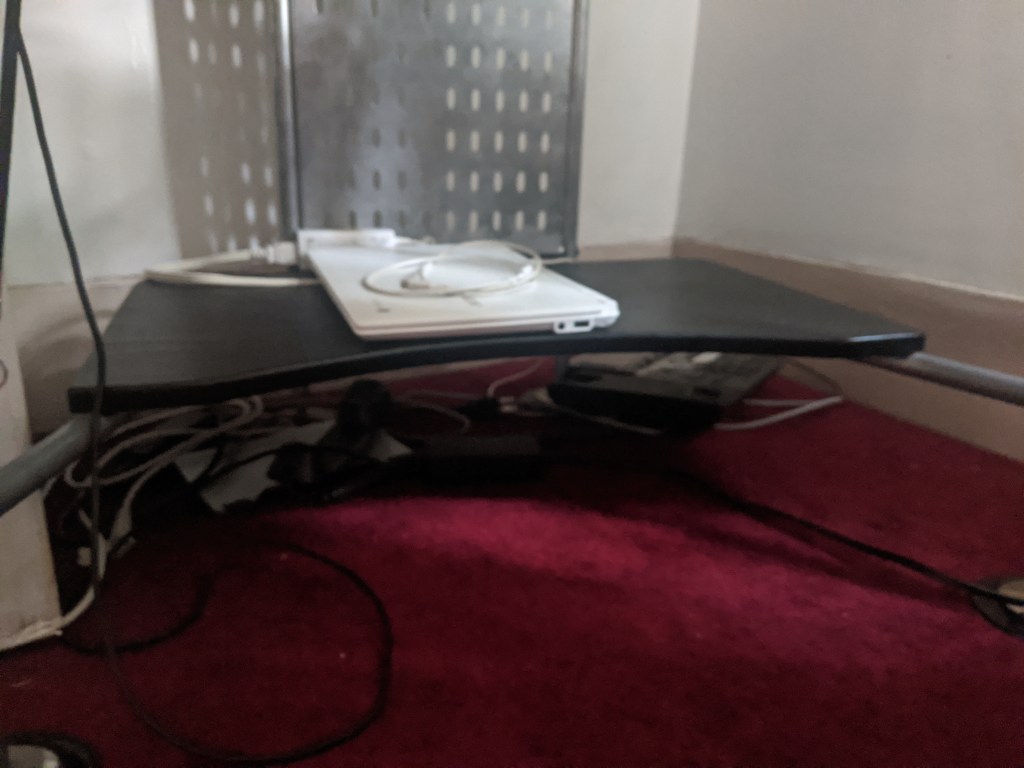
Here’s a bonus. All the wires and random hardware I hide under my desk.

The Systems of Spaceship You

Where the magic happens

It’s now been a couple of weeks into my new rule set for Spaceship Me, and I’m seeing some good results. Having rules has helped nudge me in the right direction; although one challenge I’ve struggled to shake is shifting out of the recreation station.

Rules to Rise

I’m a big fan of this quote by author James Clear, “You do not rise to the level of your goals. You fall to the level of your systems.”

In his bestselling book Atomic Habits, where the quote is found, Clear discusses four laws to making a habit stick:

  1. Make the habit obvious.
  2. Make the habit attractive.
  3. Make the habit easy.
  4. Make the habit satisfying.

Rules and systems are a way to abide by the third law. These constraints are often the simplest way to eliminate friction and create the focus we need to establish habits and arrive at our goals.

Creating a simple set of rules has helped me to rebuild a withering workout routine and manage to fall asleep when I am ready for bed. I haven’t quite reached the goals I set last week, but I’m definitely trending in the right direction thanks to these new rules.

What About Work?

While I’m making progress in a few areas, I’m still challenged to find the focus I want during my work day. Some days have been successful, but at the beginning of this week I struggled especially to stay on task and avoid distractions. I don’t know if the problem was coming off the long weekend or if some expected technical issues threw a wrench in my focus, but I found myself ineffectively working at the entertainment station while listening to some personal finance podcasts and speeches.

I am confident that if I move myself physically to the work station, I’d find the focus I desire with the rules I have in place. Sitting here writing this, I find it easier to get back to work when I find my attention slipping.

In an attempt to address this problem, I’m going to add another rule and see how it shakes out. Not moving my desk chair from the work station when taking breaks should limit the time spent. First off, it will be a nice change of pace to stand more throughout the day, as my standing “desk” hasn’t been used as often as it should be. More importantly, seeing the chair still parked at the work station will remind me what I’m supposed to be doing at that moment.

Next week, I’ll be diving into more specifics on the setup of each station and how I use them.

Securing Spaceship You

Now arriving, spaceship you.

In a similar effort to my previous trial, using BeeMinder for accountability, I’m hoping by reevaluating how I use my physical space – particularly my bedroom – I’ll see improvements in a few areas. Inspired by CGP Grey’s video, Spaceship You, I plan to better define and adhere to my “stations,” the designated spaces for certain activities.

Boundary Decay

When the video first came out in April of this year, I applied the lessons in it, created my stations, and did my best to avoid cross contamination of activities. As time went on, those boundaries crumbled.

Lately, I’ve had a bad habit of mixing my work and play areas. While working, I’ll throw on a YouTube video as “background noise,” which of course becomes my focus, as interesting ideas and jokes steal my attention from the task I’m supposed to be working on.. Then, there are times I try to work while in relaxation or entertainment mode. I’ll hop in a game with friends and tell myself that I’ll write a few sentences while I’m waiting to respawn. This goes as well as you might expect; I close my laptop shortly after the game starts.

For me, work has a lot of different forms. It can be my day job, writing, researching, editing, programming, and more. My definition of work is consistent effort on a given project. The intention with the space is to focus on a given task until I find the right time to stop.

Distractions while working were the core inspiration for this trial, but rewatching the video made me think about the other areas I am neglecting as well. Lately, my exercise routine has been lacking, even with a number of options for home workouts. Also, I’ve gotten in the habit of watching a quick video or two while laying in bed to catch up on a few channels. These are simply the result of the loss of intentionality with these spaces.

Separating Stations

While my stations are defined, what I need to now is recreate the boundaries between them. To do this, I’ve come up with a number of rules:

  1. No entertainment content while at my working desk.

With my current track record, I need to strictly avoid any entertainment while in my space to work. The only exception to this will be lyric free music and the Study With Me playlist by Thomas Frank. This doesn’t apply to just during “work hours” either. Respecting the space for what I need to do there is key.

  1. Any breaks taken during work will be done away from my work desk.

This ties into the above rule. When I’m in my work station, I plan to be doing work. If I need a moment out of the trenches, I need to step away from the desk. Moving to the entertainment station or even out of the room entirely may be needed. The ultimate point is to continue associating that space with working.

  1. If a distracting idea comes up, I’ll write it on a whiteboard and get back to the task at hand

There are times that an idea comes to mind and I start to explore it, ending in a rabbithole of twelve tabs open in Google Chrome. While doing so has led me to some interesting places, in order to maintain focus, I will write down the idea and get back on task.

  1. Eating will only be done in the entertainment station.

Eating may not seem to be a distraction, but in the end, the goal is to allow each space to only be used for its purpose.

  1. My bed is for sleeping only.

There’s a saying that goes “the bed is a place for two things: sleep and sex.” However, my lack of a partner makes the latter a bit unproductive, leaving me with sleep. In the end, I want to develop my ability to fall asleep by creating an association with laying in bed with sleep, not laying in bed reading, watching YouTube, or visiting more adult-oriented content.

  1. Prep the fitness station (roll out my yoga mat) for use in the morning.

There is a ton of research supporting exercise and its improvement to mental health and performance. While I am in okay shape, I know my routine has fallen apart recently. As part of a nightly routine, I want to set myself up with a reminder to exercise in the morning.

Any and all these rules are likely to be broken every so often, during and after this trial. Making them, however, should help to develop an expected behavior, not an impossible standard.

The Flight Path of Spaceship Me

In applying these rules for myself, I hope to see the following improvements:

  • Reduce distractions while working to less than 15 minutes per day.
  • Fall asleep in less than 15 minutes when it’s time for bed.
  • Develop a morning fitness routine.

As the trial continues, I’ll share more details on each station and how it is used, as well as how the rules above are impacting these goals.

Blossoming with BeeMinder

No time to take a break. On to the next one!

Revisiting my hypothesis for this trial, using BeeMinder as an accountability tool was more effective than I had expected. The outcome was largely impacted by adding stakes for long-term projects, as that area is where I’ve seen significant improvement. While I don’t know that I will use BeeMinder specifically hereafter, I plan to use it, or other tools, as accountability levers for any goals or habits that face frequent resistance.

Breaking the Dip

At the start of the trial, I knew focus was an area I needed to improve. While I’m not shy to start new projects, I have a hard time getting them to a level I’m satisfied calling “finished.” A couple weeks into the trial, I committed to a year-long journey of delivering a new finished project once a month.

In a prior post, I mentioned Seth Godin’s The Dip  many of my abandoned projects were those I felt passionate and excited about, only to shelf them once enough hurdles were in the way making the results not feel worth the effort. Why battle through a challenge, when there is so much to learn in a new, more exciting project?

Setting myself up with financial stakes put some skin in the game. There were several times throughout the month when I nearly dropped my current project. Knowing I’d be out $100 kept me coming back. The important thing is fighting through The Dip. The moment I knew this was a project I wanted to see completed was after getting past a big hurdle earlier this week. I felt so elated I melted in my chair, stared at my computer screen, and said aloud to myself, “I’m so happy.”

The Other Goals

The other goals listed in my hypothesis were to regulate my sleep schedule and get drafts of these blog posts completed by Tuesday night. The latter has been going well, and getting a post written definitely reduces the stress of putting something out the day of. Last week, I started my standard process for publishing the post, even though it was only Tuesday. The habit of writing then immediately publishing was so ingrained it was my immediate course of action.

Regarding my sleep, I haven’t seen too much of an improvement. I’m waking up enough days of the week to not pay my penalty but not enough to develop a consistent schedule. I definitely need to revisit my approach here and see how I can improve.

Beyond Just Money

I think sparing use of monetary pressure can really help bring habits to the forefront of the mind. No one likes losing money for bad decisions, even if it’s only a small amount. The cost brings the habit to the conscious part of the mind.

While I largely saw benefits, there were times when I started to feel the stress of losing money. This was especially true with sticking to my project. Part of me was concerned with completing it by the end of the month and caused a lot of unnecessary stress. I commonly thought of changing projects to attempt a completed product in the short time I had left. Each time, I had to talk myself through the intention of adding that price tag to stick with projects I was excited about, not to stress out because of them. My hope is that projects in future months will have enough runway to limit the stressful moments.

Something I’m particularly curious about is if non-monetary stakes would have comparable compliance with less stress. I’d also be more comfortable recommending others use similar non-monetary stakes if the results would show. I’m lucky enough to be able to lose a hundred bucks in a month if I make some bad decisions and still be okay at the end of the day. It’s certainly enough that it would leave quite a mark but not so much it would ruin me.

BeeMinder – The Verdict

My experience using BeeMinder was a good one. Getting started is easy, and there’s definitely a lot more depth into setting up goals. The service has a lot of built in automation for adding progress, of which I didn’t really need to take advantage.

The original image I had for this trial was to be a review of BeeMinder itself, but the focus shifted to financial accountability in general. In the end, I see the latter being way more important than a specific service, app, or even approach. While the option to form an accountability group may not always be available, it’s good to know there are options to stay accountable.

If you find you can use some pressure to make progress in any area in your life, check out BeeMinder, and let me know how it goes for you or if you have recommendations for non-monetary stakes.

With another trial down, I’ve once again looked to areas I can improve. Revisiting this video by YouTuber CGP Grey, I will work on improving the condition of “Spaceship You.” The idea is that the physical space we inhabit has a serious impact on our focus. Creating designated spaces for different activities from sleeping to working helps to prime us in those areas. After I first saw the video, I made some changes to my bedroom where I sleep, relax, work, and workout, in an attempt to create the “stations” Grey discusses. It’s been a few months, and of course, those boundaries have collapsed. I’ll need to make some changes both externally and internally for this one, so it’ll be a fun journey to share.

Loss Aversion and the Power of Avoiding Pain

Pleasure or pain?

So far, this experiment is turning out as expected. I’ve had more focus on hitting my targets each week and even procrastinate less often on long-term projects – though, it still may be a little too often. As the trial began, I thought back on the accountability group my friends and I had in a trial a couple years ago. So far, I’ve been left with the question, are punishments really the best way to stay accountable?

Changes Paying Off

Last week, I mentioned changes I made in the approach I was taking in my sleeping goal. Focusing on waking up has gotten me out of bed at a far greater rate.

I do seem to be in a strange loop in which I wake up on Monday, Wednesday, and Friday at the goal time but struggle on Tuesdays and Thursdays. If I were to guess, it’s due to the impact on the prior day’s sleep that is affecting me. This is because on my early wake up days, I also get to bed sooner, leading to a few more hours of sleep when rising later. I would need to investigate further to really get to the bottom of it, but I think it’s a safe observation for now.

In regard to setting the sudden goal to put out a project once a month, I took more time to start than I expected to start. I spent some time coming up with projects to work on, and after picking one, it still took me a couple days to sit down and begin work. It’s a different direction from some of my current interests but has been sitting on the back burner for about a month now. I chose it over the aforementioned “current interests” because the latter requires a lot more skill development to even get started.

In the end, knowing I had a $100 pendulum descending on me, I finally got myself in gear and started the project. It’s a short text adventure game in the spirit of Zork or Adventure, but instead of typing out commands, the player is given a few action cards. Storytelling card games have long been a fun way to tell absurd, entertaining stories amongst my friends. One friend even came up with a “ruleset” for the ridiculously titled Ye Olde Card Game, in which the goal is to make up a story using a subset of the deck. There’s some other specifics, but I think we change them every time we meet up due to not remembering the exact rules.

Impact of a Dollar

On the subject of friends, this trial has me thinking about the accountability group I met with two years ago. While we met regularly for a few months after starting, eventually we stopped. Still, we were able to get a lot accomplished in that time – all to avoid the big breakfast bill.

It was a fun way not only to push myself to get goals done, but also to meet with friends and see them making progress as well. It’s astounding the influence even a small amount of money can have on behavior. To avoid paying a few bucks, some people will go above and beyond.

The Carrot Versus the Stick

While I’ve certainly seen benefits setting stakes for myself should I fail, I am interested in the idea of comparing the impact of tying rewards to certain goals.

A commonly accepted aspect of human behavior and psychology is that we are prone to avoid losses, even when potential benefits logically outweigh the loss. Not only does this apply to risky wagers, but also to performance. In a 2012 study, student test scores were seven percentage points higher when teachers were paid a bonus upfront and would have to return it when not meeting the goal of raising scores when compared to classes of teachers who were to be paid the bonus after.

There appears to be some debate in the effectiveness of using rewards or punishments for increasing performance. I’ve found some psychologists fighting on the side of rewards being more beneficial, though in this case it was specific to children. This does tie in with the commonly accepted habit loop introduced by Charles Duhigg’s book The Power of Habit. The loop consists of a cue or trigger, a routine or behavior, and a reward. All of these elements are needed to create a habit, though I suppose one may consider the avoidance of a punishment a reward in this process.

I’m curious to hear from you. Do you find yourself motivated more by rewards or punishments associated with goals?

Adjustments Along the Way

I guess the theme for this trial’s photos will be flowers, so look forward to that!

After a few weeks of tracking my goals with BeeMinder, I realized I needed to shift my focus in my sleeping goal. Otherwise, I have a goal in place that I hope will compel me to stamp out a long running bad habit of mine, a failure to complete projects I start.

Focusing on the Real Goal

One of the goals I set for myself for this experiment was to go to bed by 11 pm at least three nights per week. The pressure to get into bed would help me build the habit of getting to bed earlier, thus waking up earlier, my real goal.

After thinking about the goal further, I decided to focus on waking up instead. Changing the BeeMinder goal to wake up by 6:30 am will instead influence the real behavior I want to change. Now, not only is there pressure for me to get up when my alarm goes off, but I still need to get to bed earlier so waking up is easier!

Accountability can be used to influence either the desired outcome directly or the behaviors leading to that outcome. Different goals may need different approaches in accountability. In the case of my sleep schedule, even when going to bed earlier, I rarely woke up at the time I wanted. I realized that I needed pressure to get out of bed in the morning, not into bed at night.

Long Term Focus

Something I realized about myself in the course of writing this blog is that I am a serial starter. I find it easy to dive in and try out anything and everything. The first few weeks are often a blast; I learn a ton and make some things along the way. A problem I have is that I am a terrible finisher. I have countless started drafts, projects, and ideas that never developed into anything further.

While not every idea or project has a definite complete state, or is even something I’m interested in pursuing, I have many ideas that I do want to complete and put out for the world to see. My major problem is a failure to finish. Getting through The Dip, as Seth Godin would put it. The project rolls up to a point where the effort needed increases and the results aren’t as immediate. At this point, it becomes easier to start something new and begin the process all over again – feeling the rush of the first few insights gained that really develop a new understanding. The problem is, this cycle has left a lengthy backlog of shelved, half-completed projects that I really do want to share with others.

In an attempt to fight this problem, I have set the goal to release a completed project every month for the next year. Instead of a small amount, a dollar here or there, I’m putting $100 down for each missed opportunity.

What will come out of this, I don’t yet know. I have a growing backlog of story ideas, game concepts, computer programs, and more. My experience in game jams has taught me that a simple idea and a limited scope can lead to interesting outcomes. For those unfamiliar, game jams are events that take place both online and offline where the goal is to create a game in a set period of time. Some jams last as long as a weekend, a week, or even a month. Others really push creators by limiting the time to one hour. The concept is simple, make and finish something.

While I’ve long struggled to complete my projects, I hope a little more pressure and a set deadline of the last day of the month will help. With $1,200 on the line, I guess I should get started on this month’s project.


Note: I’ve now set up the blog to use affiliate links to Amazon. In short, links to Amazon, and possibly other sites in the future, may provide a benefit to me such as a commission or referral bonus to me when shared. If you are not interested in the affiliate/sales links, please let me know, and I may start providing non-affiliate links, ones I don’t see get any benefits from, as well. See this disclosure page for more info.

Rebuilding Habits with BeeMinder

I’m called to habits like a honey bee to a flower.

After years of trying out a variety of hobbies, habits, and routines, I am happy with many of the ones I’ve picked up along the way. The problem I’ve been facing recently has been maintaining consistency. Many of my habits have weakened over time. To rebuild them, I’ll be experimenting with the app BeeMinder.

Purpose – The Point

With many trials under my belt, I’ve found myself hanging onto just a few habits I’ve tried out. While some of these are still going strong, others have fallen into disarray. With recent travel especially, I found myself looking for a way to get back on track and stay there.

When thinking about what this trial would be, I didn’t want to start anything new. Instead, my focus would be better spent rebuilding the structure that was supposed to be in my daily life. As I wrote down ideas, the idea of trying out products, services, and software came up, and with that an accountability app called BeeMinder did as well. Using BeeMinder, I could focus on rebuilding my poor habits, while still experimenting with a system that may benefit me in the long-term.

Methodology – The Plan

For the duration of this trial, I’ll be sticking with the app BeeMinder. There are some other accountability options out there, but I’m most familiar with BeeMinder. Admittedly, there’s a steeper learning curve than I expected, so it may take some time until I get things set up exactly as I’d like. In the long run, I may look further into alternatives, but for now, my focus is getting started.

The core premise of BeeMinder is that you are charged money for not completing specified goals. There are a variety of options for how to set goals,  from the frequency to the threshold to the way BeeMinder gets updates on progress. Having the external pressure of losing real cash for simply not doing what I want will, in theory, get me to better execute on those goals. Loss aversion can be a real motivator.

As of writing this post, I made two goals in BeeMinder:complete the blog post by Tuesday night and be in bed by 11 PM at least 3 nights per week. I wanted to start small and work up to other goals over time. I’m also looking to add an additional goal to help me stay on track with long- term projects. Something to the effect of a number of hours worked, pages written, or otherwise, depending on where I decide to put my focus for the next few months. Reviewing my annual goals, I imagine it will be something in writing.

Hypothesis – The Goal

Willpower is a fleeting resource that cannot always be relied on. Rather than assume I’ll be ready to make the right decisions when needed, using an accountability app should help push me in the right direction.

My goals from this experiment are to increase my compliance in long-term goals, increase the consistency in my sleep schedule, and to have my blog post drafts finished earlier in the week. A friend of mine offered to help with editing posts, and a few weeks now I’ve gotten them to her late in the week. Dropping them on her so late wasn’t fair. If she’s helping me out, I want to do right by her.

I hope not only to see progress for the specific goals above, but to continue using BeeMinder to keep me on track over time.

Lights, Camera, Hiatus

The last in this series, though hopefully not my last video ever.

Making videos was a bigger challenge than I expected. Not necessarily due to skills or gadgets, but the act of talking to a camera was surprisingly tough early on. My biggest challenge, however, was breaking away from the written posts. Doing both led to more stress than intended, and so I think I’ll be falling back on my roots for this blog. This trial did accomplish at least one goal, regenerating my interest in writing content.

The Good

Putting videos out felt great. Even with the few views and comments I received, making them was a fun process. While there is still a lot to learn, I had a good time coming up with how to do certain aspects like the set, script writing, and much more. It was such a new space for me, that there were many areas to experiment in.

This trial did generate the line of thought I wanted regarding my approach to these trials. In particular, I came up with a new formula to tackle posts for future experiments. Approaching posts in a methodological way will hopefully lead to more interesting writing in each. Rather than my drivelling about the prior week and progress as a whole, I instead can focus on what I’m doing, why I’m doing it, and what results I expect to see. Updates and progress will still likely play a role, but not construct the post entirely, which led to some boring posts in the past.

The Bad

My original intention during the trial was to only make videos. Instead, I had both videos and written posts being worked on each week, causing more stress than I hoped for. If I stuck to videos only, I might have seen better expectations. However, the writing process of this blog has been what’s kept me doing this for so long.

While the filming and creation process was fun, the post-production pieces like creating a thumbnail, title, and description for each video was a struggle. The thumbnail was certainly my least favorite part of posting the video. As an avid YouTube viewer, I know how important a thumbnail can be to spark interest. Coming up with engaging images to spark interest is a skill I need to develop.

The Future

While the video process was a lot of fun, I don’t plan to continue making weekly videos for the time being. The writing element of this blog is something that I do appreciate too much to let go. Creating both videos and written posts each week is a little too much for me to take on right now.

After a few weeks off, I want to try putting out a video on a monthly basis and see where it goes. As of now, I don’t know what these new videos will look like. I’m unsure if it will be the trial/self-improvement type of content I make here or something entirely different. All I know is, it’s a fun hobby I’d like to continue. The content itself will likely be an experiment in and of itself.

This type of hiatus is the exact reason I didn’t want to buy gear like a camera, microphone, lighting, etc. It’s entirely possible, I’ll never come back to making videos, and had I bought a bunch of gear, it would now be sitting in storage until I eventually got rid of it.

Now comes to the time of the long awaited next trial. This was a tough one for me. I feel that I’m in a place where most of my habits are what I want them to be, but now I need to rebuild the systems around them. To accomplish this, I’m going to be trying out the service BeeMinder. This service allows you to create certain goals and if not met, there is a financial penalty.

Beginnings and Evolution

While I’ve been writing for a few years now, I never took this blog seriously. It was a fun little hobby, and I would knock out a post each week. The problem was that over time, I grew consistently frustrated by my lack of growth.

My video this week covers the below in a more off the cuff style, but offers some other details regarding trials I’ve maintained and other ideas for the future of this project.

Why I Started Writing

In 2017, I was living in Irving, Texas. Just before moving down there to live with my brother, I started listening to several podcasts and reading books. Before then, I hadn’t been much of a reader; the closest I got to reading in my spare time was almost finishing Harry Potter and the Chamber of Secrets, until I lost the book with about three chapters left.

The chain of content led me to arrive at the person to whom I believe is truly credited with inspiring my writing, a man named Tynan. His appearance on Noah Kagan’s podcast was the first time I went back to listen to an episode multiple times. His crazy life and interesting stories had me hooked. At the time, I was also consuming everything Tim Ferriss put out, eventually introducing me to Mr. Money Mustache.

All of these influences coalesced into an idea; what if I actually started doing the things I read about and heard? So I started the first trial by riding my bike to work. This was a life changing experience after screaming at Dallas traffic from my car twice a day for months at that point. The cool breeze passing by in the Texas summer sun was nice. It was also a great chance to catch up on more podcasts, leading to more inspiration.

Time to Grow

After years of putting out the same content, I’d grown significantly as a writer but fear I’ve stagnated as a creator. The process has become pretty uninspired. The answer came to me from an unexpected place, an anime podcast. A creator I’ve long followed discussed the evolution of his content over time and said, “if I’m doing exactly the same content as I’m doing last year, to me, I failed.”

In last week’s video, I introduced a more formulaic approach for handling trials as experiments. Giving each post an identity as a piece of the scientific method is my attempt to change the content I’ve been trudging through the past year or so.

In regards to content creation overall, I feel I’ve never really taken it seriously. On a run earlier this week, I thought a lot about how I might work more consistently, as well as tools and strategies I could use to get better. Many posts I’ve written feel like a cobbled together mess, in hindsight. Forcing a post out was a way to stick to a schedule, a good habit, but it also strained my relationship with writing on occasion.

In the past few days, I’ve learned a lot on creating better quality content, methods of sharing said content, and growing. I may not be able to go 100% in all directions at once, but I want to continue making small steps to improve where I can.