Starting Small

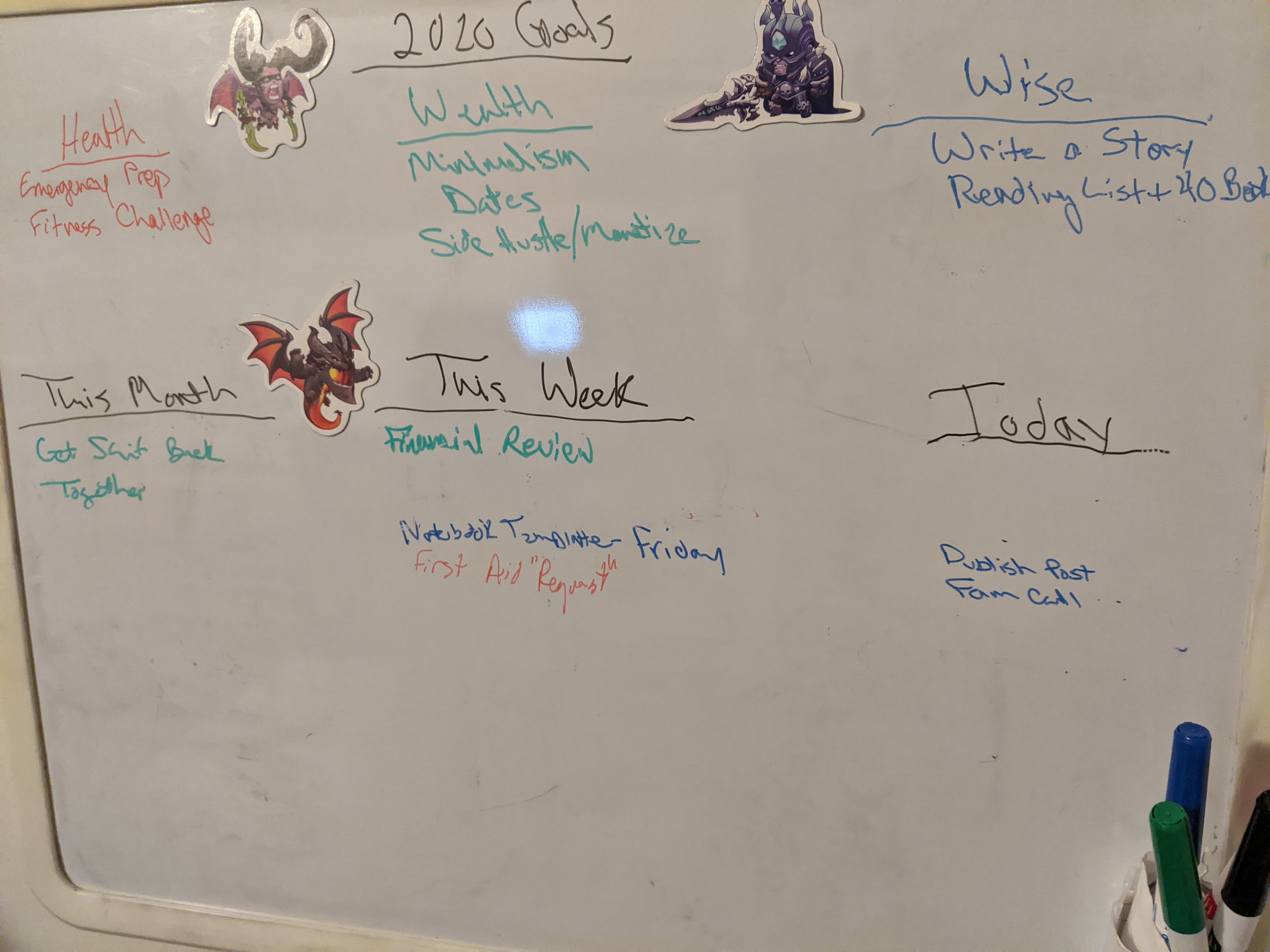
The year ahead is uncertain, but by focusing on the next thing in front of me, I can get to where I want to be.

At the beginning of last year, I was looking at bigger projects to tackle and explore and to take on goals I thought would really challenge me. I was riding a high from completing all my goals set in 2019 and thought I could get through just about anything. After the roller coaster ride of last year, I’m looking to ground myself and take a look at what’s right in front of me.

Systems Over Targets

Instead of vaguely gesturing “I want to do X,” I’m shifting my focus on the steps needed to make that goal come to fruition. In other words, what systems, habits, processes, technology, etc. do I need to make that thing inevitable?

Another big question I want to look at is “why?” Looking back, it’s probably the biggest challenge I had personally in 2020, focusing on the idea of having done something rather than the actual doing. I don’t think I have any deeper reasons for any of my goals other than “I think it’s what I should do,” or “it seemed interesting.”

I still haven’t figured out the exact answers for this year, but I believe that I’m already off to a better start. I’ve been jotting down ideas in a spreadsheet – projects to work on, places to visit, and even books to read. Just about everything has a column for the answer to “why?” For anything that requires long-term effort, I’m writing down the systems and habits I need in order to actually accomplish it.

Little Lessons

This month, I’m trying out something along those lines, keeping track of any lessons I learn each day. Whatever it may be, I’m making a list of what comes to me. I consume so much content, but it doesn’t always stick. Sometimes I feel I can see a book title and the ideas come back to me. Other times, I’ve completely forgotten the book exists.

Something I started a couple of years ago was to jot down a few notes on the book in Notion, my note-taking app of choice. That way, I could look back and see what I saw as major takeaways. Another service I’ve started recently is Blinkist. It reads highlights that I use as both a preview and review for books. These help a lot with books specifically, but then there are podcasts, videos, written posts and articles, and even just epiphanies my mind comes to on it’s own. 

Here are a some from the first few days of the year:

  • 01/01/2021 – Link habits to others, that way even on a bad day, you might find yourself going through the motions
  • 01/02/2021 – If you are trying to change someone’s behavior, determine if the change will actually help them before prescribing your “panacea”
  • 01/03/2021 – Life is learning; you have to create the lesson plan
  • 01/04/2021 – Accomplishment > Efficiency

I’ve made a spreadsheet to store all of these lessons with links to any sources, where applicable. I planned to make a page here on the site, but WordPress is uncooperative with Google Sheets.

This came to me as an idea after a few newsletters I follow pointed to this list of 100 lessons in the same week. After reading through it, with some highlights for my favorites, I thought “what if I did this for the whole year?” If I could learn at least one thing every day, I will have gained 365 pieces of wisdom.

The End of Exploration?

I recently heard someone say, “college is more about figuring out what you don’t want to do.” That’s pretty true. There were a number of courses I was interested in but didn’t end up taking, and on the flipside there were other courses I knew I had zero interest in. I find I’ve been hovering in that space, figuring out what I don’t want to do.

Era of Opportunity

The opportunities in my life really have shown me that I have the possibility to attempt just about anything. Having that degree of freedom seems great, but I often feel it leads me down a path of uncertainty. I often explore ideas ankle deep until something new finds its way into my feed. 

I might catch a concept in a podcast, book, YouTube video, or talking with friends. New and interesting hobbies, habits, routines, and practices all seem interesting, quickly grabbing my attention. It’s extremely easy to get started in nearly anything. With a steady internet connection, you can receive top tier training in just about every field imaginable.

One of the goals of this blog is to help me explore these options and figure out what works and doesn’t work for me. For one, I found I really like game development. It’s a fun and challenging process that makes me appreciate a hobby I’ve held for most of my life. Understanding all the pieces that go into making a game work fascinates me. From something as simple as a character moving across the screen to complex concepts like online-play. Nevertheless those that do extraordinary things.

Not every new interest has such a payoff. Attempting to write the 50,000 word novel for NaNoWriMo, revealed to me how much I really don’t like long-form writing. I can’t put my finger on anything in particular, but the process just feels off to me. Though writing in itself isn’t something I dislike, these posts, for example, are often a great way for me to express what’s in my mind.

However, fiction writing isn’t something I’m entirely put off by. Early in the year, I wrote a number of short stories, probably 500 words or less, that I thought were fun. With the time dilation of this year, I even forgot a screenplay for a short film I started for an idea that came to me during a flight. I found it much easier to focus on the characters, which I find to be the more interesting part of writing. I think that’s why I’m also very drawn to role playing games like Dungeons and Dragons, another past time I do a lot of “writing” for.

A Double Edged Sword

While I’ve been able to try many different projects and hobbies, I find I have one remaining problem. I often fail to allow myself to truly immerse myself in a given task for more than a few weeks. The ability to shift gears in order to try out something else I’ve discovered, just in case I like it, has led to a significant number of half abandoned projects.

I fear my consistency in leaving behind so many projects has developed an inability to see things through. That’s what led me in my pursuit of a tool like BeeMinder to provide an incentive to challenge that habit.

At the same time, I find being willing to put down projects when I find little benefit to be very helpful. The relief of stepping away from the NaNoWriMo 50,000 word commitment felt like I took off a weighted vest. I’ve been in a considerably better mood now that I’m not stressing about trying to force myself to do something I wasn’t enjoying.

A question I’ve learned to ask myself throughout my many projects is this: Do I enjoy the process of this or just the idea of having done it? With the novel for example, I learned in trying to write that I like the idea of saying “I’ve written a novel.” The actual writing of a novel doesn’t really interest me in the slightest, though I’ve had actual visions of myself alone in a hotel room or cabin writing away my magnum opus.

Through this process, I think I have figured out what I do like about writing fiction. I like coming up with interesting scenarios that characters are in and how they react, not necessarily a complex plot that moves through different acts. The screenplay, for example, was me thinking about the feeling of being confined on an airplane which led to the idea of strangers being stuck in an elevator. I created the characters and had them interact. I don’t really know what the “plot” is, but the story simply becomes the actions of the characters.

I think that’s why I like roleplaying and video games, because the player is the primary plot device; it’s their actions that create the plot. Sometimes, it’s one that the player simply passes through without much control, but other times, the player has the freedom to create a story unique to themselves. This is especially true in completely open table top games like D&D, where there’s no programming limitations to keep track of what a player can do.

This blog on the other hand is something I enjoy doing, even in some sense on the weeks I dread writing.

Stopping the Start

Throughout this blog, I’ve tried a number of new things, some of which have stuck, and others not so much. I plan to continue experimenting with a few things, but I want to move away from the “projects” that I’ve been pursuing. For example, podcasting, YouTube videos, and so forth.

While experimenting with my daily life, I want to start building on the hobbies and projects I’ve found interest in. Game development is a big one that I have really enjoyed, but am intimidated to try and take seriously. It’s an industry I’ve been interested in for nearly my entire life, and it’s allowed me to find a lot of great stories and experiences. I have a number of ideas I want to expand on, but all of them have at least a small link to games. Perhaps, I’ll be able to leverage what I’ve found to enjoy through the past few years of experimentation and focus on those parts of the process.

I see the future of this blog to be focused on habits, and perhaps just some general posts on life, personal philosophies, and things I’ve learned. With that in mind, I plan on taking December off to wind down for the holidays, and begin planning that future. I hope you are able to enjoy the upcoming holidays safely, and I’ll see you in the new year.

Media Makes Us

It’s in the game.

As I’ve been working through the story I’m writing, I’ve been thinking a lot about the media I consume -how it influences my thoughts and actions.

Shaping Interest

I’ve watched the YouTube channel of Ryan Hollinger for a couple years now. He creates video essays exploring the horror genre and what the themes reveal about humanity. I see this as the primary influence on the story I’ve been writing this month. Combining horror themes with concepts from different story ideas I’ve had in the past has been interesting. It feels kind of like putting together a puzzle.

Throughout my life, a number of shows, movies, games, and books have led me to different interests. An anime called Dr. Stone made me want to learn more about engineering and primitive science. The story follows a modern scientist who ends up in a sort of post-apocalyptic world after all of humanity is turned to stone by a strange green light. I bought a reference book on engineering, andI even managed to find a manual from 1903 for people in a variety of careers at the local library given away for free. Looking back on old remedies and processes was informative, since so much of what we see and use today is beyond common practice.

Shaping Action

Media has not only shaped my interests but has often inspired me to actually go out and pursue those interests. It might be as simple as wanting to workout after a shonen action series has a training arc.

Reading a manga about wine professionals got me interested in trying more varieties. It’s been fun to try different styles, pair them with different foods, and prepare them differently. There’s still an incredible amount to learn if I really want to understand wine, but just knowing I decided to explore the subject was because a writer somewhere was passionate enough to tell a story about wine makes me happy.

This has, so far, been primarily focused on fictional media. The effect nonfiction has on my decisions and interests is even greater. There are so many trials I’ve explored simply from watching a documentary or YouTube video, or reading a blog post or book. For example, reading a post about personal finance inspires me to make better decisions with my money.

Mastering the Micro

Taking time to focus on the smaller things I’ve been neglecting.

The last few months I’ve felt in a rut. Each trial has been an attempt to shift myself out of that feeling. I keep thinking, “if I could just focus on one obstacle and overcome it, things would get back in the groove.” Time and time again, I start to quickly lose interest and try to find a new target. Rather than a large goal being my focus, I’m shifting my attention to the smaller things, my daily routines and habits.

My Five Daily Habits

My daily habits are the following five activities: a morning stretch, reading a page from The Daily Stoic, creating something, reading part of a book, and meditation. Near the end of September, I started letting days go by where I’d complete just one or two of those activities.

Weeks passed and I was still putting off these simple things I set for myself to do. Instead, I thought that if I just focused on one big project, somehow that would help everything fall in place. The reality is that I became overwhelmed  keeping up with everything I was trying to juggle at once. As always, hindsight is clear, and I don’t really know what I was thinking.

The stretch and Daily Stoic goal have been an easy thing to mix into a routine. I typically read the page first before going downstairs to make a cup of coffee. Then, I go through the stretch routine while the coffee brews. The other three I once made time for in the day but recently became incidental to decompressing from the workday. Some time after work to let my mind rest has been nice, but it’s often become a slippery slope, as I faced in an earlier trial.

Throughout this year, I’ve frequently questioned the merit and purpose of many of my trials and goals. A question I keep coming back to is do these things line up with even larger goals I have in my life?’ The challenge I’ve faced the past few years is the instability of those long-term goals. 

Since thinking on a large scale has led to a failure to complete a number of goals I set out for the short term, my attention, instead, for the next few weeks is going to be on habits. I hope in rebuilding those, I can remake a foundation on which I can start looking further into the future with more clarity and confidence.

Writing

With this in mind, I’ve been torn the past few days whether to continue the challenge I set out for the National Novel Writing Month. Trying to hit 50,000 words isn’t impossible, but I’ve set myself up with a considerable climb to get to that goal. As of this writing, I have a little less than 400 words written.

As mentioned last week, my goal was to use a combination of a word goal each week and a time goal each day. The use of both an input goal (time) and an output goal (words) was intended to help keep momentum while not causing stress each day.

Though my focus is going to be on the five daily goals, luckily one of those involves creating things. I don’t know that this shift is going to allow me to hit 50,000 words, but in the end, I still want to put forward an effort to complete something. The goal I set out for this year was to write a “story” not a novel.

Writing a Novel

For several years now, I’ve been familiar with the National Novel Writing Month challenge but never participated. After finding fun and success in game jams, I wanted to join this year. Writing fiction is a new endeavor for me, but one of my goals this year.

What is NaNoWriMo

The National Novel Writing Month is a challenge to write a 50,000 word story in the month of November. The story can be on any subject or of any genre. The goal is to finish a story.

I’ve been familiar with the challenge since the end of my college career, and have been interested in participating for a couple years now. After participating in a few game jams, the concept seemed more and more appealing.

Game jams have helped provide me with short periods to focus and complete given projects. The limitations of the short timeframe and specific goal have been a good way to learn a lot and complete projects.

Goals and Focus

My big push for the last stretch of the year is to complete as much of my annual goals as I can. One of those goals is to write a story, something I’ve wanted to do since starting this blog. While I’ve mostly written from first hand experience and non-fiction, writing a fully fictional story sounds like a fun challenge to try.

Admittedly, it will be a tough challenge to try and overcome, but I think I have some minor goals in place to help. On a daily front, I’m looking at a time worked goal of 90 minutes of writing. Weekly is where I’m looking at a word count to hit. Using both an input and output goal I’m hoping will help to keep me on track.

With that said, my posts the next few weeks will likely be on the short side, but I hope they still have enough solid information on progress and takeaways. As of the first half of this week, I’ve been distracted with the stream of news regarding the US election. With the excitement winding down, I’m hoping to get back to the habit I want to set.

Goals in Sight

Target acquired.

Keeping my post relatively short this week, as I don’t have much to say. I’m still working on getting back to goals and so far have been making progress. I’m also very excited for what I have planned next!

Goals and Purpose

People set goals all the time to accomplish the tasks in front of them. Some are expansive and broad, while others are precise and specific. Setting goals gives us direction in what is essentially an unbound life. We always “can” pursue near infinite avenues – each having its own set of consequences, good, bad, or neutral.

A number of my goals this year were based in taking some ideas to the next level, while others were to begin work on areas I’ve long put off, like my dating life! At the end of September, I found myself falling into the deep end of some bad habits. While progressing back, I am looking over my goals and wondering in what way can I commit to them.

Taking steps to get on track for progress on each goal has been a boost to morale. I’m far from perfect in my daily habits but happy with the progress I’m making to get back to where I want to be.

I do want to highlight that I am still finding time to relax and have fun while getting back into things. While playing Destiny led me to develop a bad game addiction, by letting go of trying to accomplish every little thing in the game, I’ve been able to enjoy the time played far more. Most often, play time is spent with friends, one of the key reasons I started playing in the first place.

NaNoWriMo

I’ve spent a few days considering this as my next trial, but I think it will be a great way to get myself into good habits, while tackling a challenging goal I set for myself. For the month of November, I’ll be participating in National Novel Writing Month, a challenge to write a 50,000 word story in a month’s time.

One of my goals this year is to write a story; I don’t see a better opportunity to challenge myself to do so than this one here.

Making Momentum

This simple tool is getting me back on track.

Over the last week, I mostly spent my time trying to get back in the swing of things, particularly focusing on my annual goals. After weeks of bad habits, I needed a wakeup call. While I’m far from where I’d like to be, taking small steps to get back to a “good place” is all I can do now.

Re-Evaluating Goals

At the end of last year, I was feeling highly motivated and happy with the accomplishments I made in 2019. Kicking off this year, I was ready to tackle a number of tough goals that would really push me out of my comfort zone. As we all know, this has been a challenging year and emotionally draining.

While it’s certainly possible to accomplish goals in trying times, it certainly becomes an additional challenge. My biggest hangup was questioning the legitimacy of my goals when there are so many bigger problems in the world. At times, I would feel pessimistic about something as little as reading some more books when the world was literally on fire. This pessimism shifted from concerns about problems to avoiding them.

Falling off hard into a spiral of escapism for a few weeks somehow reminded me that even the little things can be important. With the little time left in the year, I wanted to review my goals and determine what I could still accomplish with the little time remaining and what I could change to still progress toward the underlying objective.

Easy Solution – Lists

One of the biggest practices I’ve used for getting back on track has been making a daily list of what I need to accomplish; starting small helps make progress possible. Lists have helped significantly in getting me focused on what I need to get done. Setting a standard for myself to complete a few tasks to progress my goals builds momentum, something I terribly need. 

In addition to the daily list, weekly goals help direct what those daily tasks should consist of. What I determine to get done in a week is often a step needed in my annual goals, though not always.

For example, this week, I’d like to have ordered a first aid kit as part of my goal for enacting an emergency plan. The weekly goal is to order the supplies for one, but one of my daily goals was simply to reach out to a friend and ask a question I had for him. The daily goal helps complete the weekly goal, and the weekly assists the annual.

Making progress each day, even if it’s the smallest step, may help me rebuild the severely lost momentum.

Pulling the Plug

Nightly walks have continued to help me get my head straight.

This was a tough post to put together, I spent a couple days debating on how I wanted to move forward. In the end, I want to pull the plug on the aim training trial. This experiment was supposed to be a fun series of posts, but instead I ultimately used it as an excuse to justify a bad habit of addiction.

Slippery Slope

Over the past couple of months, I’ve slowly been giving more of my time and attention to the game I’ve mentioned in several past posts, Destiny 2. It’s a fun game that offers a great experience, and even some great cooperative challenges with friends.

Video games aren’t inherently bad, but I’ve been pouring far too much of my time into Destiny. In a year that offers an existential crisis every other week, it’s been nice to have a simple straight forward set of tasks and distractions. They range from relaxing busy work to narrative stories that expand the lore. Some missions even require working with friends to overcome big challenges.

The biggest thing that is pressuring me to keep playing is time pressure to complete certain content before it’s “vaulted” in November. This pressure has me rushing through as much as I can before it’s gone.

Focusing Forward

The challenge I had this week was to decide if I wanted to continue the trial of aim training. I felt it was a bit too much of a distraction at this time. It was something I’d been using as an excuse to feel productive before hours of play. In the end, I really wasn’t getting anything I thought “mattered” done. While the practice was nice, and I feel I’ve gotten better, in the end, I just feel it needs to be put to rest with my bad gaming habit.

I’d been having moments of clarity every so often that I needed to step back and focus on what I truly felt was important, but was comfortable in the ease of the game. I hope that sharing this problem here will help push me in the direction I know I want to go, towards my goals.

I want to take a step back and focus on the goals I set all the way back in January. While this year wasn’t quite what I expected, I can still make progress towards those goals. The next few posts will be discussing what I did to get back on track and how I changed my expectations now that it’s October.

Slow Progress, But Still Progress

Getting those reps in.

This week really reminded me of how much starting from what feels like scratch can suck. Moments arise that look like progress, but the very next is regression. The thing about progress is that it’s so slow we hardly notice it. I’ve also given some thought to the idea of my current gear and its impact on my progress.

No Montages in Real Life

Montages are a popular story-telling device that allows a long period of time and growth to flash by in a moment. Arguably the most notable montage in history is Rocky running through the streets, punching meat, and finally ascending the stairs at the Philadelphia Museum of Art. Unfortunately, real life doesn’t have as simple of a device to consolidate months of hard work into a few minutes of a catchy beat and video clips showing steady improvement.

Another challenge of real life training is how quickly progress can recede. In this case, I’ll use running as my point of reference. As a long time runner, I can usually knock out a few miles with little trouble; this is largely because I try to keep up with at least a few runs per week. After a few weeks off, a run today was not only tough but much slower than previous times.

This doesn’t just apply to physical talents, but mental ones. There are times I’ll take a break from puzzles like sudoku, only to come back and struggle on easy puzzles. It’s important to keep certain skills sharp and talents honed for whenever we may need them.

Mindfulness in Training

One of the biggest takeaways I’ve found thus far is the need to be focused. Coming back to running, I can usually let my mind wander and explore ideas as they arise on a run without impacting my pace. While aim training, it’s not quite as lenient.

There were a number of sessions this past week that I’d complete a good round, only to get caught up in the success and just fall apart in the next round. Not focusing on the task at hand tended to have a pretty clear correlation with my performance.

Focus is something I still need to work on, even after weeks of environment tuning.

Gear or Skill

The last thing I’ve considered after starting training is buying a new mouse. For most things, I tend to be able to work with what I have, but there are some things in life that I find the extra investment really is worth it.

Several years ago, I worked in a shoe store. My boss would (semi) joke with customers that “you should invest in a good mattress and good shoes, because when you’re not in one, you’re in the other.” It’s something I can attest to, the latter especially. Once again circling back to running, it’s amazing what a good pair of running shoes can do for pain and injuries.

Regarding my current aim training, there are a lot of moments when I feel tension in my hand and wrist from gripping my mouse intently for so long. Even consciously trying to relax doesn’t fix the problem, as the pain is caused by my attempts to control my movements quickly. My options are slow down or change strategy.

Long gaming sessions have enough moments of downtime and relaxation that allow me to ease up on my grip. While aim training, I try to move through the challenges pretty quickly so I’ll only take a few seconds of breaks between each round.

With this in mind, I’m considering trying some different mice to see what works best for me. If you have any recommendations, feel free to let me know in the comments!

Taking Aim

Ready. Aim. Fire.

For most of my life, I’ve been a devout gamer. Games are one of my favorite ways to engage with a story, spend time with friends, just kill some time, or do all at the same time. My recent interest in Destiny 2, an online first person shooter with both player vs. player (PvP) and player vs. environment (PvE) elements, I wanted to learn as much as I could to get better. This led me to a training routine focused on FPS play.

Why Train Games

While I’ve played games of many genres, I’ve had a deep fascination with Destiny 2 lately. The game has found its way consistently into my mind, pulling my attention with plans for my play sessions to maximize my progress. It’s style, story, presentation, and mechanics all work well together to make a great experience. My admiration for the game and cooperative play with friends have encouraged me to get better.

There’s a phrase in gaming communities often spoken when someone is seeking to improve, “get good.” While sometimes there is a clear path, often it’s up to the individual to figure that out. I always think of the game that popularized the saying and was my first major experience with it, Dark Souls. Many who love the game often experienced their first moments in the series as gruesome challenges that seemed insurmountable. After getting a better understanding of the game, a specific encounter, and maybe some ingame improvements, the feeling of finally conquering a boss or zone that led to many deaths is pure satisfaction.

For much of my gaming career, I’ve steered away from first person shooters, not feeling like I’m very good at them. Even with years of practice in many different games, I can get by and have a good time but never feel capable of high level play. Doing some research on improving led me to resources that should help with just that. As a fan of self improvement, I’m excited to try and get good.

In the end, I’m looking for an opportunity to improve while having some fun.

The Routine

While looking into getting better at Destiny specifically, I came across a YouTube channel that dives into a lot of aspects of the game, as well as some more broad topics in gaming. A video simply titled Does AIM TRAINING actually work? caught my attention. The arguments convinced me to give it a try.

The video cites a training guide written by an author known as “AIMER7.” In the guide, a game called Kovaak’s Aim Trainer is used as the primary training tool. The game is interesting, as it’s primarily a mishmash of custom made minigames to practice different types of mouse movements and aiming. Some scenarios focus on snapping between a series of targets, while others are about following along a moving target.

The guide offers different routines for different skill levels and different specializations. In my case, I’m following the complete beginners’ complete guide which consists of six different scenarios to practice different aiming skills. I’ll share more specifics of each as the trial continues.

Training Goals

Getting started, I wanted to get a benchmark of where I was beginning. The guide recommends playing the scenario “Cata IC Long Strafes” in which a giant pill shaped target dashes around a small room while the player shoots it until it’s health points are drained to zero. Afterward, a new pill appears. The player has a limited time to kill as many targets as possible. In my first few attempts, I averaged around 20% accuracy and killed five pills in a minute.

While the guide suggests daily practice, I don’t feel I can really dedicate that much time to the hobby. Even still, I hope after four weeks of practice to improve my accuracy from 20% to 30% with a pill kill count of seven.

I also see this training as an opportunity for mindfulness practice. During the training sessions I’ve done so far, I paid attention to all the things I could. What ways was I getting in my own way? What adjustments could I try? How did each adjustment affect performance? Why did I keep falling into certain habits? Asking questions during practice was a way to deepen my understanding of my shortcomings and where I needed to focus. I hope practicing in this manner will allow me to apply similar strategies in any other area I want to develop.