Aim to Automate

Interesting to watch, impractical for daily life.

Throughout the duration of this blog, I’ve found a consistent pattern, it’s significantly easier to remove something than to add it. There are always tasks we can’t or sometimes would rather not eliminate, and for those, I’m looking for a middle ground, automation. While the word brings to mind robots or computer code, I’m viewing the coming weeks from a simpler approach, systems to minimize or eliminate manual intervention.

Systems Over Tech

Automation isn’t all about technology, sometimes utilizing a system or process to minimize the action or thinking around a task. Habits can be thought of as systems for daily practice.

Developing habit chains can act as an automated process when the action becomes second nature. For example, I perform a quick stretch routine every morning while my first cup of coffee is brewed. This process takes no thought at all, and the trigger is something that I actively want, making the habit easier to stick to.

Even something as simple as a checklist can act as a tool for improving a process. A study introducing a surgery safety checklist showed positive results. With the checklist in place, surgery related death dropped from 1.5% to 0.8% and impatient complications dropped from 11% to 7%. I’m not medically educated enough to draw a conclusion beyond those numbers decreasing being a good thing.

The To Do List

I started this trial coming up with just about every manual task I perform from writing these posts to taking a shower. While I don’t plan to automate my hygiene through some Back to the Future-esque Rube Goldberg machine, it was a fun practice to really think about all the little things that add up over the day. It’s beneficial to find those small actions that over the course of days, months, and years can really add up. Once found, some of those tasks can be eliminated or automated, freeing up all that time forever onward.

Lately, email has been one of those tasks for me. There are a number of emails I basically delete every time they fall in my inbox. Others, I skim through and archive. Others still, I let sit in my inbox a little too long and may one day wipe the dust off and give them a gander.

Something I’m really looking forward to investigating is building systems for simplifying DnD preparation. For a few months now, I’ve whittled the process down using the “Lazy Dungeon Master” method, but there are still some things I’ll spend more time on than I really prefer. Sometimes coming up with random encounters or events can take serious brainstorming to keep them interesting, yet balanced. The game has a lot of systems for setting up randomness, but I’m not the biggest fan of many of them.

One of the last areas I’m looking at for this first week is automating my finances. I have most of my money troubles automated with direct deposit, autopay options, and scheduled transfers, but there are a few even simpler systems that I found will be incredibly helpful. Coming back to the idea that not every improvement needs to be a major tech advancement, the simple introduction of a calendar item would have saved me a couple minutes and some anxiety. When doing some shopping over the weekend, I was trying to remember which categories which credit card offered bonuses for and went through a couple apps to find them. Then, at the next store, I’d already forgotten and it was back to tapping through apps. Both instances were, of course, moments before I was to pay, and so I was flipping through trying to find the info as fast as possible.

These areas offer a simple and tangible place to start simplifying in my life.

Fun’s Not Hard With a Library Card

An environment designed to pass through as quickly as possible.

Going to the library has not only offered me a place for consistently getting work done, it’s also opened my eyes to some of the bigger issues of the last few months. Through a combination of complacency and laziness, I allowed the change in my environment to excuse a long term behavioral shift. With the turn of the new year, I looked back and came to terms with my bad habits and began to put them to rest. While going to the library was a simple practice, it set the stage for a number of good habits.

Environment Design

The underlying goal of this trial was to make a space for being productive. It’s easy to say that this was a success. I’m writing more consistently as well as progressing on other projects. Regular trips to the library built the foundation, but with several weeks of getting things done, I’m able to do all this even while not at the library. 

Environment doesn’t exist only as physical space, but can be influenced by all five senses. I’ve been enjoying a particular nighttime tea while reading or writing practically every night. The cup not only made the activity more enjoyable, I looked forward to engaging because delicious tea was in store.

Another alternative is music. I’ve found an artist recently that I really enjoy listening to while reading. While there is singing, it’s in Japanese so I don’t get pulled into the song. I often read just before bed, so the calm, melancholic tunes help get me primed for bed too.

All Part of the Plan

In most areas of life, having a plan beats not having one. Knowing what to accomplish and how has been huge for me not only at the library, but also week to week.

Making plans can easily become an excessive practice, but pinning down the major strokes has guided me to make better decisions. Focusing in on one major thing each week has helped to push me toward overall goals. I’ve long had this feature of my weekly reviews, but I feel like I’ve only just started really reaping the benefits of it. One week is as simple as getting the right amount of sleep, and it sets the pace for multiple weeks now.

Creating momentum with trips to the library has made working at home even more productive. Setting high but manageable expectations for myself each week helped create the mindset I need to work well regardless of where I am.

The Testament of Trials

Returning to using the framing of a trial for posts also pushed me to publish more consistently. Framing the possibilities to only the things I can relate to what I’m currently working on makes getting started and limiting to where I can actually get things finished.

Trials not only give me a direct subject to build on, but provide a general sense of motivation. As I’m performing the actions or even just reflecting on them, I have an excitement about what I’m experiencing and want to share that excitement.

Reestablishing a weekly deadline has probably been the most critical decision in writing. Doing so forced me to write more consistently, because I knew I needed something by the end of the week. Otherwise, I’d just have to publish the post in its current state, whether I’m happy with it or not.

With the year starting off with a solid foundation, it’s time for the next trial. Instead of focusing on things to do, I’m looking to see what manual tasks in my life can be minimized or completely automated through heuristics and technology. I haven’t completely settled on the areas to focus on, but I do have some ideas including a few things like email management and automating electronics.

Battling the Self

There’s an infinite number of ways to cross a pond, but all of them require that you start.

Being at the library challenges me to get work done even when I’d rather be doing anything else. At the time of writing, I’m dealing with a lot of distractive thoughts and problematic feelings, but sitting here at this library desk, I’ve been able to put that aside and get plenty accomplished.

Getting the Ball Rolling

I am an easily distracted person. Knowing this, I had to create these structures to get myself to be effective. Whether it be a space at home or elsewhere, I need somewhere that gives me the nudge to start working on something, regardless of how I feel or what else is pulling at my attention at the moment.

Once I start, I tend to dial in more and more. The flow state is frequently the goal, but not always required. At times, all that’s needed is 10-15 minutes of undistracted output to make substantial ground.

Getting started can be the hardest part without a plan. That’s why I find it so important to take the time to come up with a rough outline to get started at a given time. It can be easy to fall into a trap of looking for something to spark, but it’s possible that it won’t happen until you can really get into it.

Sometimes starting on anything at all is the best practice to simply get in the right mindset. I think of the Morning Pages from the book The Artist’s Way by Julia Cameron. The idea is that each morning you write three pages of pure freeflow thoughts onto the page. This practice, also called freewriting, clears the mind of distractive thoughts and allows you to build on that free flowing state of mind. The goal is to write now and edit later.

Another useful system that I’ve started employing more is the Pomodoro Technique. The idea is simple: start a timer and focus deeply during that duration, typically 25 minutes. After that time is up, a short break can be taken, usually about five minutes. The idea is to keep moving through these ebbs and flows of work and breaks until deep enough in the work that the break isn’t necessarily required, but always an option.

As with many systems I enjoy, this one is of course completely flexible for a given practice, person, or precise moment. Maybe a full 25 minutes is needed to get the momentum needed. Alternatively, there are times when a shift towards a productive mindset seems like a substantial task, but five minutes of reading, writing, or whatever task is needed at the time doesn’t seem too bad.

Work as a Distraction

Systems like the Pomodoro Technique are useful to simply take any circumstance we are in to push towards a more productive practice. Sometimes we just need a few minutes to put aside the things weighing us down and work on something else, however using work as a means of ignoring real problems can often do nothing but make a situation worse.

I think it’s critical to understand if the problem that’s being avoided is something that is within a reasonable sphere of control. There’s a big difference between doing the dishes for some relief in grieving over the death of someone close and staying at the office an extra hour to avoid coming home to a failing relationship. The latter is something that needs attention and is work in itself, while the former is an emotional burden that may only need time to process.

Some things just need work and attention themselves. Taking the time to sit down with these problems, be they alone or with someone else. Problems can range from material issues to emotional ones. The former can be a bit simpler to manage, but certainly not always easier. There’s usually a specific problem that can or cannot be addressed.

Emotional issues, however, can be far more complex. Therapy is of course an option, though it can be expensive even with services like Betterhelp that reduce the cost overall. Sometimes all that’s needed is to say them outloud to anyone who will listen. Other times, some action or advice can help, but often it’s getting the ideas out of our heads that helps reduce their effect. 

If a more personal approach is preferred, journaling or writing can help to give the thoughts a more concrete image. Freewriting about the current hangup can lead to uncovering problems that were buried beneath.

Either practice can be good for working through an issue. Depending on the severity and level of control we have, sometimes putting it aside for just a few hours on a given day may be all that’s needed. For myself, these trips to the library have helped me put aside the thoughts that had me down. A few weeks ago, I struggled to get myself off the floor, not to mention out the door. Even at the library, it was hard to get anything done, but after a few minutes of freewriting, I was able to accomplish a fair bit.

Working certainly didn’t resolve my issues, but I was able to put them aside and produce some results. The distraction was long enough to let the negative feelings pass by, and now I feel like I can move forward without them weighing me down.

A Return to Scheduled Programming

Looking back at an old friend.

The first few weeks of the year were a bit of a mess figuring out how I wanted to move forward. I spent a number of days basically writing out what I wanted to get done, largely coming up with the theme. With this in mind, I then came up with rough outlines for days and weeks. Giving myself more or less goals for what to get done at certain times of the day or on a given day of the week.

Weekly Work

With my current theme in mind, I wanted to develop a regular schedule to build momentum on with regular progress. Currently, my outlook is the first six months of the year, any farther and I’m not sure I’ll be able to confidently stick to the plan while still giving myself pressure to get those early items done. This time frame is long enough to make progress, while not being too long if it turns out the goals I have in mind aren’t the right ones for me now.

While six months is the long term perspective I’m taking, breaking those months down into weekly plans has been beneficial. The time frame of a week has worked really well for me for a long time. Starting with the weekly review process that I still uphold to this day, looking back and then forward for a week allows me to set structures to make the progress that I need and can handle for the short term.

Recently, I’ve spent some time building a structure for what I could consider an ideal week. I wrote out the tasks and activities I wanted to get done on a given day and with approximate  times I generally work on those items. For example, on Mondays I want to get to the climbing gym and then work on a game development project. This is of course after working my day job, yet the plan still offers time to relax. While not every Monday will play out perfectly, having a plan in mind should give me the nudge needed more often than not.

The ideas also rely on a standard day. Holidays, vacations, and special occasions can all toss these plans to the wind. Having plans for 95% of days is better than worrying about all the exceptions and caveats ahead of time. When those unique days arrive, I can deal with them then.

Library Time

To bring the subject to focus for this trial. Last week, I wrote up how I was looking to get my visits up throughout the week. The solution: actually plan it out!

The daily plans gave me that push I needed to get out the door and in the library to work before I was able to settle in for the night. Putting a library visit down for Saturday and then a flexible visit on either Wednesday or Thursday has improved my attendance. The flexible day has been a great option, as I can adjust plans as needed while still getting time at the library.

I’ve written in the past on very specific time tracking, but I think having more of a high level structure works better than minute to minute type management. Deciding I want to go to the library after work one day, and then climb and play video games the next is much easier to stomach than trying to map out an entire week in 15 minute increments.

Because planning is key, knowing what I actually want to get done at the library has also been critical. It might be as simple as writing some loose ideas and drafts for the blog or to transfer loose paper notes to a digital system. I tend to write a lot of planning notes for Dungeons and Dragons and then have a system for getting sessions planned in a single page.

The key project for the library is writing these posts. Each visit allows me to build on the blocks laid out during the last. Posts develop more and more as the week goes on. Once a post is finished, I outline the next one. This gives me a starting point for the next visit. Each time expanding the text, clarifying ideas, or editing out parts that don’t fit the larger thesis.

A Place for Work

A cozy corner to get things done.

I wrote extensively in my short series on “spaceship you” the importance of separating spaces with intention. Over the last several months, I’ve struggled to get myself to work at the level I’d like. I think a large part of this has been a lacking structure in my new living space.

Changes in Environment

At the time of writing the spaceship you posts, I was living in a house with a few friends. At the beginning of our move, I was the only one working remotely full time, and so I was lucky to grab the largest bedroom consisting of the entire attic.

Since moving out of that space, I’ve lost the element of physical separation in living spaces. I spend a large amount of time in my bedroom, typically working my day job. Then, I tend to wind down watching videos in bed or sitting at the same desk further to play games. With so much time dedicated to other things in that space, it is challenging to focus on being productive.

Overall, my new living arrangements are great My roommate and I get along well. We spend a fair amount of time together, and have frequent plans with friends both online and off. However, I still wanted to find a space specifically for working on my own projects.

A Local Solution

Because I was failing to make this space at home, I decided to look outward. Luckily, the local library is close, just a few minutes walk. While certainly not as convenient as a solid workspace at home, given the limitations I have, I’m more than happy to get out for a few hours a week to really sit down and focus.

Lately, I’ve made an effort to go to the library at least once a week, though I want to get these numbers up. Once there, I find it easier to sit down and write, even if it’s just the outline or rough ideas I have for a post, as distractions are less intrusive. I know I’m there for a purpose and doing anything else feels wasteful.

This is far from the extreme changes of previous trials, but has a pretty clear cut benefit that I’m already seeing in action. My goal with this simple trial is to get the year started off in a better direction and rebuild habits that I’d lost in my move. One could say to build a foundation.

Absurdism, Optimism, and a Cartoon Dog

Two responses to the same idea. Image source: Reddit.

Of all the realms in philosophy, ideas relevant to the self and different worldviews have been the ones I resonate with the most. Across the many schools of philosophy, existentialism makes the most sense to me. I recently finished reading Albert Camus’s classic work The Myth of Sisyphus which discusses some foundations of existential thought. I’ve long been familiar with the ideas in the book, provided to me primarily through media.

Mister Peanut Butter and The Absurd Man

My introduction to Camus, and a lot of philosophy actually, was the YouTube channel Wisecrack. Exploring the philosophical influences in media is the primary subject of their videos. Frequent appearances are made by existential philosophers, most often through two cartoons about substance abusing leads, Rick and Morty and BoJack Horseman.

As a fan of both series, the videos by Wisecrack were the exposure to the deeper ideas within. As the shows progressed, I found myself wondering which worldviews I found myself engaging in and which I truly would want to hold.

Enter, the happy go lucky yellow labrador named Mister Peanutbutter of BoJack Horseman, the show not the horse-man. The character is overwhelmingly friendly and audacious, much like a real life excited pup. He comes off as annoying and irritating when first introduced to the audience, especially through the eyes of our point of view character, BoJack, who can’t stand him for his painfully optimistic and friendly attitude.

As we get to know the characters more and more, BoJack is revealed to be a worse and worse person and we’re challenged to think about those around him more. As Mister Peanut Butter is developed, we see his friendly face drop for what might be the only time in the show. Confronting BoJack for a shitty thing he did – keeping things as spoiler free as I can.

His optimism is challenged when a family emergency calls him back to his hometown, a place full of other yellow labs. His brother Captain Peanutbutter is introduced in the same in your face manner, tackling Diane, Mister’s wife. Yet, when alone with Diane he breaks into these brief lines of an existential crisis. It’s revealed he has a medical condition, and Mister takes on his same depressive attitude, waxing poetic at a raven-person atop some nearby power lines. After hearing back from his brother and his own escapades in the episode come to a conclusion, he saves a drunk and drowning BoJack and breaks bad news. After which he happily shouts “None of this matters!”

That joyful exclamation of the inherent meaninglessness of the shattering news given to BoJack has stuck with me to this day. I recall a number of times living in Texas with my cousin both looking at each other and quoting Mister Peanutbutter.

Revisiting the episode for this post it’s clearer that Mister Peanutbutter is simply celebrating his brother’s health, but when first watching, I found Mister Peanutbutter to walk away as Camus’s “absurd man.” The absurd man is one who accepts the meaninglessness of existence, but doesn’t let this crumble him. Instead he embraces it and even finds comfort in this. I still see Mister Peanutbutter mostly through this lense. He has his moments, but throughout the majority of the show, he is able to live happily without a worry for the bigger meaning of it all, as BoJack loses himself trying to find purpose.

When I was first watching through the series, I began to face my own existential crisis. Answers I’d long held onto like religion and identity were starting to fall away. As I started to have trouble dealing with these ideas, a cartoon dog shouted to me, “none of this matters!” It was in that phrase that I allowed myself to relax and embrace the absurd.

Philosophy and Media

I briefly touched on the importance of media analysis in my life about a year ago. It’s funny how a piece of entertainment can shape perspectives more than years of education. All types of media can offer a range of ideas from a cast of characters, setting, event, or all at once. Characters with opposing philosophies can work against each other or together exploring how these ideas interact. The setting itself offers philosophical exploration. Dystopian novels come to mind as the prospective endpoint of certain belief systems.

A friend of mine has told me she doesn’t understand how I can read and enjoy so much philosophy. I find it acts as the foundation of how I understand and interpret other works. Learning about philosophy and theory shapes how we understand all the things we read, play, watch, or engage in anyway.

Interpretation is largely guided by the ideas and perspectives we understand. It’s how people can read completely different meanings in the same text, for example the idea that Netflix’s recent Squid Games is anti-communist when the creator explicitly stated his intention for the show to be about capitalism. I personally don’t think there’s a “wrong” interpretation of a piece of media, just perhaps one either lacking or influenced by a particular belief system.

Laying the Foundation

Looking at the year ahead with the enthusiasm of this flexing bee.

Last year, I briefly mentioned the concepts of themes in a trial on journaling, one borrowed from the YouTube channel CGP Grey. The gist is at times of inspiration, such as the start of a new year, a better model for goal setting is to start with a high level concept to give direction rather than specific resolutions. With the time of resolutions upon us, I want to take a stab at setting a theme for the year ahead. Over the last few months, I lost momentum with a ton of habits and practices and so I’m currently following the theme “Foundation.”

Themes Versus Resolutions

A few years ago, I started one of the few trials I still stick to consistently. A weekly review that focused on my progress in a few important categories. The idea was to pick a timeframe that was easy to look back at and give myself grades based on performance in those important areas. Rather than a specific resolution, picking areas that I want to focus on throughout the year fell somewhat into Grey’s concept of themes.

Themes serve as a guiding idea to determine how time should be spent. Themes should have three elements, broad, directional, and resonant. While specific goals can be associated with them, the theme itself should be a general concept that can adapt specific behavior as time passes, but still maintain the desired direction. To quote the video, “In picking a theme, go with something that has a nice broad name for the general direction you want to navigate your life.” As time passes, the intention of a given theme may change. The timeframe of a year leaves a lot of room for change, and Grey even suggests having themes for shorter periods like seasons, but in the spirit of the New Year, something always jumps out.

This broad idea serves as a compass to follow when making decisions. When a decision presents itself, the theme can serve as a deciding factor into which choice to make. It can also serve as a general litmus test for what choices I even regard as necessary.

To illustrate with an example, let’s look at “year of health” versus “I want to run three times a week the entire year.” A year is a long time and a lot can change. An injury can prevent consistent practice. Weather or outside conditions may make practice dangerous or unwise. It can even be as simple as running just doesn’t give the spark it once did. Anything getting in the way of that specific goal set months, weeks, or even days ago fails to stick and the feeling of failure sets in. With the theme of health however, running can just be one part of the year. The goal can be to focus on recovering from that injury or to find a new exercise routine that does bring the joy running once had. Maybe even as time passes, fitness was never the big problem, so the focus shifts to correcting a bad sleep schedule or diet. The theme is able to connect to a wider range of behavior that carry our runner to their desired outcome, a healthier life.

To reference the video again, the most important element is that the theme is resonant. Over the last few weeks, I came up with a number of ideas for what to pick as a theme for the year. After all the brainstorming, I kept coming back to the word foundation.

What Does Foundation Mean?

With my eyes on the year ahead, I want to focus on two different areas: my regular habits and really starting just one long term project.

There are a few projects I’ve envisioned getting started over the last few years, but none ever got the full effort they really deserved. Rather than the long, difficult challenge that I knew that should have been, I’d get started, not see progress, and then move onto something else. Instead, I want to focus on getting the basics in order. This will range from habitual practice to tangible progress. The former of those I feel is more critical.

Consistency is something I’ve frequently struggled with over the last few years, but I’ve done a terrible job in the last several months. Getting myself regularly working on a single thing for a sustained period has been difficult. I’ve shifted from jumping between projects to working on nothing at all. Finding the right cadence of practice is critical for making progress.

In terms of the actual progress made on this currently undecided project, it will largely be contingent on the nature of the project. I have a few ideas in mind including a video game, tabletop RPG modules, and a fantasy webcomic, but all of which exist as a vague gesture of an idea. Meditating on which one feels best for the theme will be a focus on the next few weeks.

One major habit I’ve fallen out of is writing. Even the last few weeks, after announcing my return, were chock full of procrastinating and jumping drafts to find an idea I felt I really wanted to share. However, I do have a plan to work on this already.

Trials for Foundations

One of the foundations I want to restore is the act of trials driving the content for my posts. I may still find time to take breaks from trials, similar to last year, to write on broader topics. However, this time around, I want to try something a bit different, to plan and announce a few of the trials I’ll be doing ahead of time.This isn’t an exhaustive list of, but some of the ideas I have as of now.

While the next few posts will be focused on elements of my personal philosophies, I’ll also be starting the first trial in a long time. It’s a simple one but re-establishes elements of another CGP Grey related series of posts, “Spaceship You.”

After moving in May of last year, I slowly started to lose elements of focus in the design of my living space. The bedroom I moved into is much smaller than before, though the collective space is used much more. The biggest issue I run into now is my work and play are at the same desk. Previously, I had two separate areas for work and play which made sitting down to write much easier. To get myself working consistently, I’ve found that getting out of the house completely is about the only solution. Thus, trips to the library have been very productive. I want to turn those trips into a more concrete part of my schedule.

In a completely different corner of my interests, I also plan to finally pick up an idea I’ve had for many years, learning to play the harmonica. An interest grew a few years ago to play music again, and the simplicity and portability of the instrument stood out. By simplicity, I mean more in the sense of it’s overall design, not necessarily the practice of playing. Only time will tell how complex or simple that is.

Plans in Place

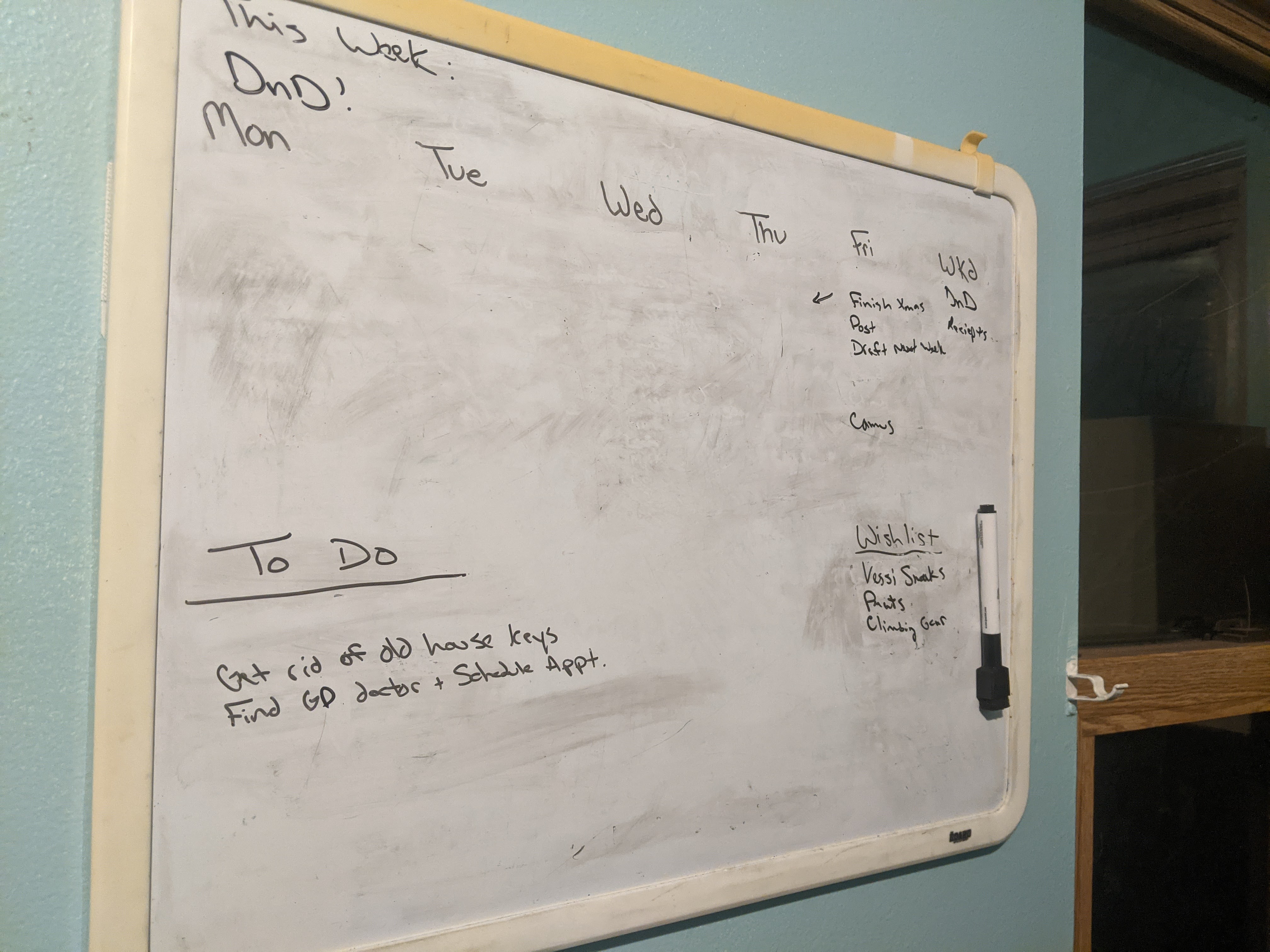
Normally there’s more on the board, but I realized most of it was Christmas shopping plans this week.

For a few months throughout this year, I thought I would be able to get away with a relaxed approach to a lot of activities. From blogging to working out, I figured I’d make the time for what was important and only allow the occasional distraction to get in the way. Of course, this optimistic perspective was often thwarted by the reality that distractions are good at their job. Days would pass by as I skipped runs during marathon training, no projects were progress, and the only thing getting done were bounties in Destiny 2. Eventually, I got the ball rolling with a better approach, this bold new idea called “planning.”

Training Plans and the Start of a Better Trend

As the months passed and my marathon training stagnated, I knew I needed to make a change or it was going to be a painful 26.2 miles. I sat down and made a daily workout plan to follow from the day to the marathon.

There were of course on the fly alterations, days where I was feeling hurt or other plans required swapping some days around, but I was still doing much better than before.

Prior to a real plan, the biggest problem I was having was getting myself to do specific workouts, like running hills and paced tempo runs. Days I wanted to do these workouts coincidentally landed on days I just really didn’t feel like running. Once a schedule was put together, it was easy to force myself out the door knowing I’d committed to doing so already.

Daily Life and Weekly Reviews

The fitness realm was only the start for establishing better plans. The only way I’ve been able to consistently get what I want done in a day is to write it all out.

Days where I feel the most productive are those in which I set up a loose plan of what needs to be done. Even better are those in which I estimate the time to actually get those things done. It doesn’t matter if I wake up late or have something take a bit longer, I tend to get through most of my list if I just take the time to write it all out.

One of the few trials I’ve stuck to since has been the writing of a weekly review. In an effort to help plan ahead, an addition I’ve made since the trial has been coming up with a single focus for the following week. It can be something specific like getting my Illinois driver’s license after moving or something a bit more general like writing for fifteen minutes per day. Either way, there’s a specific plan that needs to be completed.

Plans and Creativity

For a while, I’ve held onto a false belief that too much rigidity would get in the way of creative actions like writing. This is a bad habit I fall into from time to time, assuming I’ll make the time when needed. As we saw for the last few months, that time never came until I made it.

While I think too much structure can inhibit creation, as the trial format was growing dull leading to my more freeform posts, planning can help to keep the wheel spinning. With this blog, I didn’t set aside any time to write, leading to a lengthy hiatus. While the broad topic posts gave me more freedom of subjects, the trial structure gave me the more important directive to write every week.

Looking ahead to a return to trials, as I plan for 2022, I think I want to pursue a similar approach to CGP Gray’s “Themes.” Planning for not only a trial for a given month, but a possible tangential idea to accompany the new habit or routine. With of course a possible unrelated post, but one at least planned ahead to be released at a given time.

The whole point of switching to writing on broad topics was to build a backlog of posts to avoid the very problem I’d found myself. Instead, I have a backlog of half finished drafts and ideas, none of which are ready to be published, something I ran into already this week when I opened the planned post to find it still had notes and questions to be answered.

The Return

At long last, a light in the dark is reignited.

After an unplanned, unannounced hiatus, I am back for regular posts. Time off was both unplanned and unexpected. Week after week I kept thinking, I should write a post, but nothing ever gave me that push. I don’t exactly know what is around the corner, but I want to get back to writing frequently.

A Much Needed Break

While there wasn’t anything specific that caused my hiatus, I felt creatively stunted. I had several drafts that I felt were 90+% finished, but none felt of value enough to publish.

The first week without a post, I originally planned to just take the week off, as I’d done several times prior. Then, I just stopped. I hadn’t felt a pull to get back to writing for the last several weeks. I kept thinking I “should” but never really wanted to. So instead, I just let the time pass until I felt something of an urge.

I wish I could say I did something productive during the time off, but instead I mostly played some games and spent time with friends and family. I did squeeze in just one quick marathon and even read a few books, though not as many as I would have liked.

In the end, I spent the time recharging and setting myself up with more to talk about.

Moving Forward

This month, I’ll be touching up some of the posts I had sitting in a backlog and finally publishing a few of them. I’m happy with the ideas behind the posts, but need to get them to sound less like incoherent rambling.

Come next year, I plan to return to a trial format, with perhaps some general posts thrown in the midst of things.

Regarding this “trial” to stop doing them, I definitely felt less of a pressure to write which was kind of liberating at first, but in the end led to this unexpected time off. It was nice to recharge, but part of me feels like I let down anyone who enjoys reading these posts regularly and even myself a bit for somewhat giving up for a short time.

To get back on track, at the start of next year, I plan to get back to the old format with a four week long trial to start the year off with plenty to write about.

Writer’s Block and Getting from Start to Finish

Sometimes writing is like passing through a thick layer of fog, you have to take it one step at a time.

Lately, I’ve had a hard time getting my ideas down in a manner I’m proud enough to publish. With a growing list of ideas and drafts, I’m finding it harder focus on a single idea. Rather than sit down and force myself to get something out each week, the recent changes to my approach to the blog have given me a bit too much time to linger with ideas.

The Importance of Starting

Sometimes the biggest challenge is getting started. Staring at a blank page is painful when waiting for inspiration to settle in.

The best way to get started is to just begin typing words. The ideas don’t even need to be coherent or make sense grammatically. Opening the flow from the mind to the page is the goal.

There will be times when a word or idea will get caught up. It might be trying to find the right word or phrasing, but going with the first thing that can give enough of an idea later is best. The point of starting is to deal with the editing and fine tuning later. Once the words are on the page, the idea will form more concretely.

It is difficult to always know how a piece of work will turn out before it’s been started. While only in the mind, it has too much room to shift around and change, but once started, it begins to find structure.

The Importance of Finishing

While not all projects require a final checkbox to be considered a success, having it in some state of completed is a good way to leave it behind with some degree of catharsis.

I find this especially true when it comes to sharing ideas. Every perspective on an idea has something new to offer. Sitting on a pile of drafts is preventing some ideas and perspectives from seeing the light of day.

Something to keep in mind is that finished today doesn’t mean finished forever. An idea can always be revisited. A version two released. A post edited or updated. The finish line today can serve as the starting line tomorrow.

Becoming a serial starter is an easy slope to stumble on, I am certainly one battling that now. After years of brief starts with little left to show for it, I’m trying to put my energy into more substantive projects. I have some ideas for where I want to put that energy, but am weighing them before getting the ball rolling.