Keeping my post relatively short this week, as I don’t have much to say. I’m still working on getting back to goals and so far have been making progress. I’m also very excited for what I have planned next!
Goals and Purpose
People set goals all the time to accomplish the tasks in front of them. Some are expansive and broad, while others are precise and specific. Setting goals gives us direction in what is essentially an unbound life. We always “can” pursue near infinite avenues – each having its own set of consequences, good, bad, or neutral.
A number of my goals this year were based in taking some ideas to the next level, while others were to begin work on areas I’ve long put off, like my dating life! At the end of September, I found myself falling into the deep end of some bad habits. While progressing back, I am looking over my goals and wondering in what way can I commit to them.
Taking steps to get on track for progress on each goal has been a boost to morale. I’m far from perfect in my daily habits but happy with the progress I’m making to get back to where I want to be.
I do want to highlight that I am still finding time to relax and have fun while getting back into things. While playing Destiny led me to develop a bad game addiction, by letting go of trying to accomplish every little thing in the game, I’ve been able to enjoy the time played far more. Most often, play time is spent with friends, one of the key reasons I started playing in the first place.
NaNoWriMo
I’ve spent a few days considering this as my next trial, but I think it will be a great way to get myself into good habits, while tackling a challenging goal I set for myself. For the month of November, I’ll be participating in National Novel Writing Month, a challenge to write a 50,000 word story in a month’s time.
One of my goals this year is to write a story; I don’t see a better opportunity to challenge myself to do so than this one here.
Over the last week, I mostly spent my time trying to get back in the swing of things, particularly focusing on my annual goals. After weeks of bad habits, I needed a wakeup call. While I’m far from where I’d like to be, taking small steps to get back to a “good place” is all I can do now.
Re-Evaluating Goals
At the end of last year, I was feeling highly motivated and happy with the accomplishments I made in 2019. Kicking off this year, I was ready to tackle a number of tough goals that would really push me out of my comfort zone. As we all know, this has been a challenging year and emotionally draining.
While it’s certainly possible to accomplish goals in trying times, it certainly becomes an additional challenge. My biggest hangup was questioning the legitimacy of my goals when there are so many bigger problems in the world. At times, I would feel pessimistic about something as little as reading some more books when the world was literally on fire. This pessimism shifted from concerns about problems to avoiding them.
Falling off hard into a spiral of escapism for a few weeks somehow reminded me that even the little things can be important. With the little time left in the year, I wanted to review my goals and determine what I could still accomplish with the little time remaining and what I could change to still progress toward the underlying objective.
Easy Solution – Lists
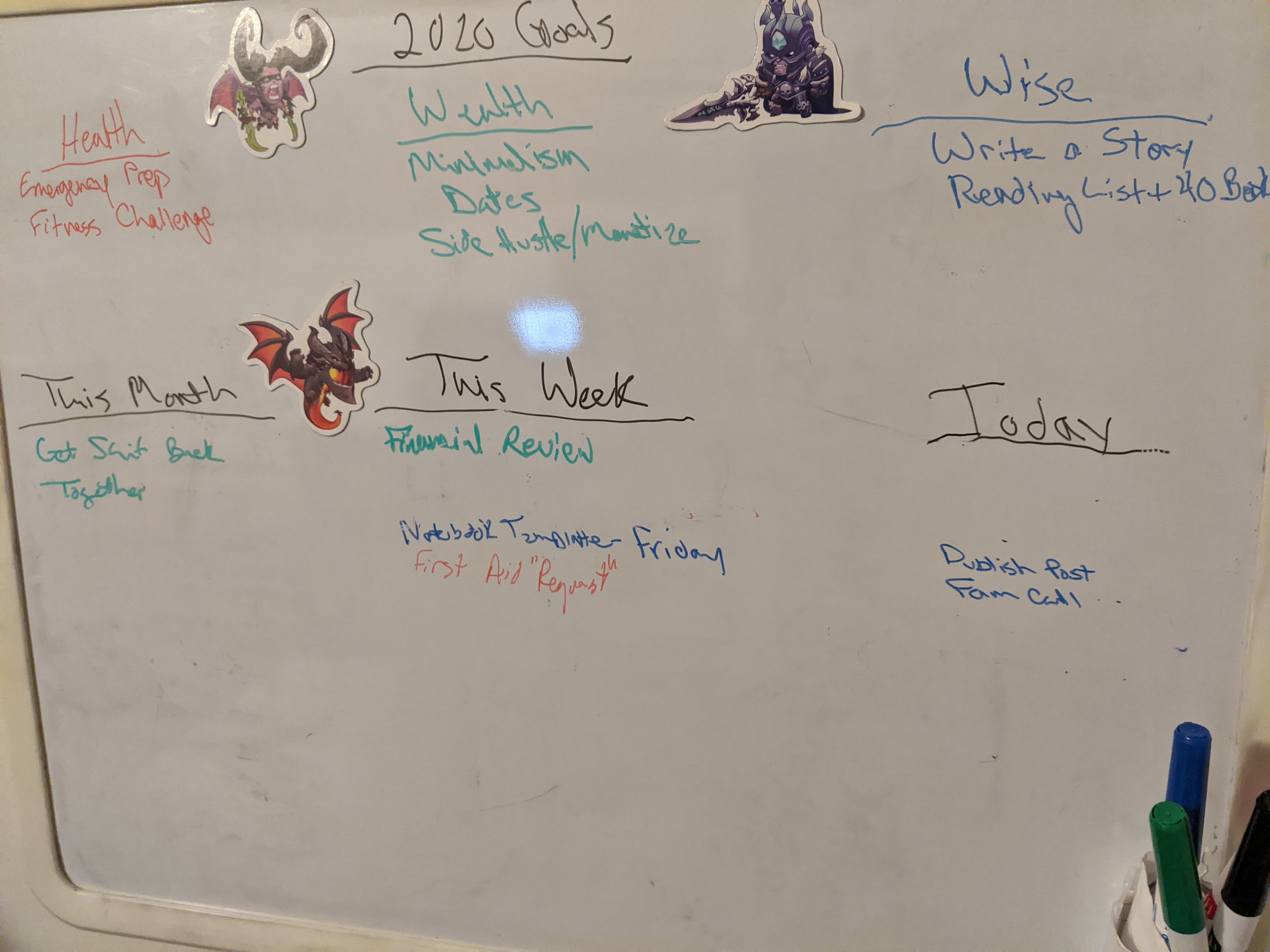
One of the biggest practices I’ve used for getting back on track has been making a daily list of what I need to accomplish; starting small helps make progress possible. Lists have helped significantly in getting me focused on what I need to get done. Setting a standard for myself to complete a few tasks to progress my goals builds momentum, something I terribly need.
In addition to the daily list, weekly goals help direct what those daily tasks should consist of. What I determine to get done in a week is often a step needed in my annual goals, though not always.
For example, this week, I’d like to have ordered a first aid kit as part of my goal for enacting an emergency plan. The weekly goal is to order the supplies for one, but one of my daily goals was simply to reach out to a friend and ask a question I had for him. The daily goal helps complete the weekly goal, and the weekly assists the annual.
Making progress each day, even if it’s the smallest step, may help me rebuild the severely lost momentum.
Nightly walks have continued to help me get my head straight.
This was a tough post to put together, I spent a couple days debating on how I wanted to move forward. In the end, I want to pull the plug on the aim training trial. This experiment was supposed to be a fun series of posts, but instead I ultimately used it as an excuse to justify a bad habit of addiction.
Slippery Slope
Over the past couple of months, I’ve slowly been giving more of my time and attention to the game I’ve mentioned in several past posts, Destiny 2. It’s a fun game that offers a great experience, and even some great cooperative challenges with friends.
Video games aren’t inherently bad, but I’ve been pouring far too much of my time into Destiny. In a year that offers an existential crisis every other week, it’s been nice to have a simple straight forward set of tasks and distractions. They range from relaxing busy work to narrative stories that expand the lore. Some missions even require working with friends to overcome big challenges.
The biggest thing that is pressuring me to keep playing is time pressure to complete certain content before it’s “vaulted” in November. This pressure has me rushing through as much as I can before it’s gone.
Focusing Forward
The challenge I had this week was to decide if I wanted to continue the trial of aim training. I felt it was a bit too much of a distraction at this time. It was something I’d been using as an excuse to feel productive before hours of play. In the end, I really wasn’t getting anything I thought “mattered” done. While the practice was nice, and I feel I’ve gotten better, in the end, I just feel it needs to be put to rest with my bad gaming habit.
I’d been having moments of clarity every so often that I needed to step back and focus on what I truly felt was important, but was comfortable in the ease of the game. I hope that sharing this problem here will help push me in the direction I know I want to go, towards my goals.
I want to take a step back and focus on the goals I set all the way back in January. While this year wasn’t quite what I expected, I can still make progress towards those goals. The next few posts will be discussing what I did to get back on track and how I changed my expectations now that it’s October.
This week really reminded me of how much starting from what feels like scratch can suck. Moments arise that look like progress, but the very next is regression. The thing about progress is that it’s so slow we hardly notice it. I’ve also given some thought to the idea of my current gear and its impact on my progress.
No Montages in Real Life
Montages are a popular story-telling device that allows a long period of time and growth to flash by in a moment. Arguably the most notable montage in history is Rocky running through the streets, punching meat, and finally ascending the stairs at the Philadelphia Museum of Art. Unfortunately, real life doesn’t have as simple of a device to consolidate months of hard work into a few minutes of a catchy beat and video clips showing steady improvement.
Another challenge of real life training is how quickly progress can recede. In this case, I’ll use running as my point of reference. As a long time runner, I can usually knock out a few miles with little trouble; this is largely because I try to keep up with at least a few runs per week. After a few weeks off, a run today was not only tough but much slower than previous times.
This doesn’t just apply to physical talents, but mental ones. There are times I’ll take a break from puzzles like sudoku, only to come back and struggle on easy puzzles. It’s important to keep certain skills sharp and talents honed for whenever we may need them.
Mindfulness in Training
One of the biggest takeaways I’ve found thus far is the need to be focused. Coming back to running, I can usually let my mind wander and explore ideas as they arise on a run without impacting my pace. While aim training, it’s not quite as lenient.
There were a number of sessions this past week that I’d complete a good round, only to get caught up in the success and just fall apart in the next round. Not focusing on the task at hand tended to have a pretty clear correlation with my performance.
Focus is something I still need to work on, even after weeks of environment tuning.
Gear or Skill
The last thing I’ve considered after starting training is buying a new mouse. For most things, I tend to be able to work with what I have, but there are some things in life that I find the extra investment really is worth it.
Several years ago, I worked in a shoe store. My boss would (semi) joke with customers that “you should invest in a good mattress and good shoes, because when you’re not in one, you’re in the other.” It’s something I can attest to, the latter especially. Once again circling back to running, it’s amazing what a good pair of running shoes can do for pain and injuries.
Regarding my current aim training, there are a lot of moments when I feel tension in my hand and wrist from gripping my mouse intently for so long. Even consciously trying to relax doesn’t fix the problem, as the pain is caused by my attempts to control my movements quickly. My options are slow down or change strategy.
Long gaming sessions have enough moments of downtime and relaxation that allow me to ease up on my grip. While aim training, I try to move through the challenges pretty quickly so I’ll only take a few seconds of breaks between each round.
With this in mind, I’m considering trying some different mice to see what works best for me. If you have any recommendations, feel free to let me know in the comments!
For most of my life, I’ve been a devout gamer. Games are one of my favorite ways to engage with a story, spend time with friends, just kill some time, or do all at the same time. My recent interest in Destiny 2, an online first person shooter with both player vs. player (PvP) and player vs. environment (PvE) elements, I wanted to learn as much as I could to get better. This led me to a training routine focused on FPS play.
Why Train Games
While I’ve played games of many genres, I’ve had a deep fascination with Destiny 2 lately. The game has found its way consistently into my mind, pulling my attention with plans for my play sessions to maximize my progress. It’s style, story, presentation, and mechanics all work well together to make a great experience. My admiration for the game and cooperative play with friends have encouraged me to get better.
There’s a phrase in gaming communities often spoken when someone is seeking to improve, “get good.” While sometimes there is a clear path, often it’s up to the individual to figure that out. I always think of the game that popularized the saying and was my first major experience with it, Dark Souls. Many who love the game often experienced their first moments in the series as gruesome challenges that seemed insurmountable. After getting a better understanding of the game, a specific encounter, and maybe some ingame improvements, the feeling of finally conquering a boss or zone that led to many deaths is pure satisfaction.
For much of my gaming career, I’ve steered away from first person shooters, not feeling like I’m very good at them. Even with years of practice in many different games, I can get by and have a good time but never feel capable of high level play. Doing some research on improving led me to resources that should help with just that. As a fan of self improvement, I’m excited to try and get good.
In the end, I’m looking for an opportunity to improve while having some fun.
The Routine
While looking into getting better at Destiny specifically, I came across a YouTube channel that dives into a lot of aspects of the game, as well as some more broad topics in gaming. A video simply titled Does AIM TRAINING actually work? caught my attention. The arguments convinced me to give it a try.
The video cites a training guide written by an author known as “AIMER7.” In the guide, a game called Kovaak’s Aim Trainer is used as the primary training tool. The game is interesting, as it’s primarily a mishmash of custom made minigames to practice different types of mouse movements and aiming. Some scenarios focus on snapping between a series of targets, while others are about following along a moving target.
The guide offers different routines for different skill levels and different specializations. In my case, I’m following the complete beginners’ complete guide which consists of six different scenarios to practice different aiming skills. I’ll share more specifics of each as the trial continues.
Training Goals
Getting started, I wanted to get a benchmark of where I was beginning. The guide recommends playing the scenario “Cata IC Long Strafes” in which a giant pill shaped target dashes around a small room while the player shoots it until it’s health points are drained to zero. Afterward, a new pill appears. The player has a limited time to kill as many targets as possible. In my first few attempts, I averaged around 20% accuracy and killed five pills in a minute.
While the guide suggests daily practice, I don’t feel I can really dedicate that much time to the hobby. Even still, I hope after four weeks of practice to improve my accuracy from 20% to 30% with a pill kill count of seven.
I also see this training as an opportunity for mindfulness practice. During the training sessions I’ve done so far, I paid attention to all the things I could. What ways was I getting in my own way? What adjustments could I try? How did each adjustment affect performance? Why did I keep falling into certain habits? Asking questions during practice was a way to deepen my understanding of my shortcomings and where I needed to focus. I hope practicing in this manner will allow me to apply similar strategies in any other area I want to develop.




 Trying Out Before Buying In